匋
Character Story & Explanation
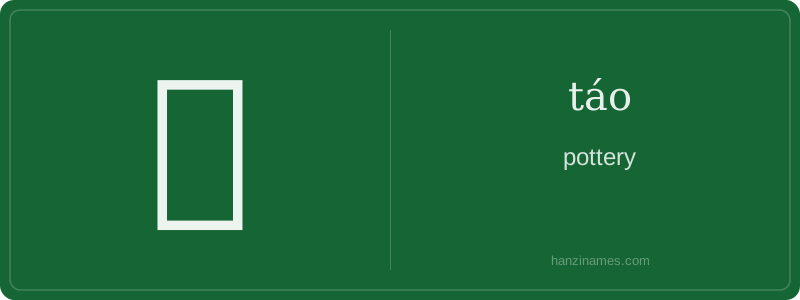
匋 is a rare, archaic variant of 陶 (táo), used almost exclusively in historical linguistics, epigraphy, and classical art contexts. It appears in pre-Qin bronze inscriptions and Han dynasty bamboo slips but was largely supplanted by 陶 after the Qin standardization. Today, 匋 survives in academic publications on early Chinese script and in the names of specialized ceramic research institutes — e.g., the 'Chinese Academy of Cultural Heritage's 匋器 Section' (though 陶器 remains the term in public signage).
The character’s origin is not pictographic but phono-semantic: 勹 acts as a simplified semantic hint for 'enclosed vessel', while the lower part (historically linked to 余 or 奴 in variant forms) contributed phonetic value. No oracle bone form of 匋 is attested; its earliest secure attestations are Warring States bamboo manuscripts.
Our detective work begins with the radical 勹 — a 'wrapping' or 'enveloping' shape, often associated with containment and enclosure. In 匋, this radical cradles the lower component, suggesting something held or shaped within — fitting for pottery, which is formed by enclosing clay. Though 匋 looks simple, its structure reflects ancient craftsmanship: the act of molding material into a vessel.
Historically, 匋 is a variant form of 陶 (táo), the standard character for 'pottery' and 'ceramics'. While 陶 dominates modern usage (HSK Level 4), 匋 appears in ancient inscriptions, regional scripts, and seal-carving traditions. Its eight-stroke form preserves an older, more streamlined silhouette — a compact glyph favored in calligraphic shorthand and pre-Qin bronze inscriptions.
This character invites us to consider how meaning persists across graphical variants. 匋 isn’t obsolete — it’s archived: seen in scholarly texts on paleography, museum catalogues of early ceramics, and names of traditional kilns. Its survival underscores how Chinese writing balances standardization with historical layering — like unearthing a Song-dynasty shard beneath a modern studio floor.
Example Sentences
Common Compounds
Similar Characters — Don't Mix These Up
Your First Step into Chinese Culture: Get a Chinese Name
Every journey into Chinese begins with a name. Use our free Chinese name generator to create a meaningful, personalized Chinese name that fits you perfectly.
Get My Chinese Name →