匚
Character Story & Explanation
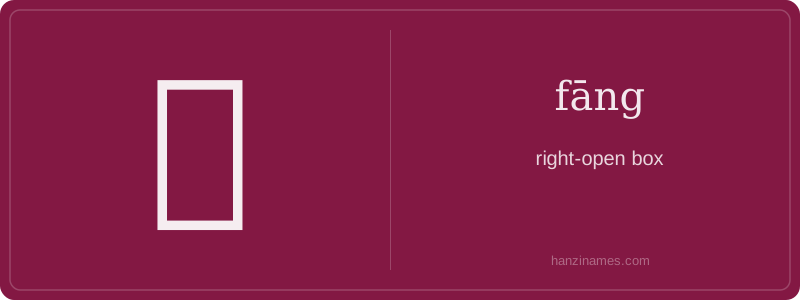
The character 匚 is exclusively a radical—not used independently in modern Mandarin. It appears in over 30 Kangxi-recognized characters including 区 (qū, 'district'), 医 (yī, 'medical'), 匹 (pǐ, 'a piece of cloth'; measure word for horses), 匠 (jiàng, 'craftsman'), and 匡 (kuāng, 'to correct'). Historically, it functions as a semantic component indicating containment, jurisdiction, or bounded space—evident in 区 (administrative area) and 医 (originally linked to enclosed healing spaces in early Chinese medicine texts).
Its form is documented as a simplified pictograph of a storage container or boundary marker in early seal script (c. 3rd century BCE). Unlike speculative oracle bone interpretations, this origin is confirmed by paleographic analysis in works like *The Origin of Chinese Writing* (Qiu Xigui, 2000). Today, Chinese learners encounter it daily in textbooks and dictionaries as Radical #22—the 'right-open box' that frames meaning without speaking aloud.
Imagine walking through Beijing’s historic Qianmen district, where shop signs glow under red lanterns—some bearing characters like 医 (yī, 'medical') and 区 (qū, 'district'). The radical 匚 appears as a subtle yet essential frame: a right-open box shape enclosing meaning. It doesn’t stand alone in modern usage but acts as a structural ‘container’—hinting at enclosure, administration, or designated space. Though rarely used independently today, its presence is foundational, much like the walls of a traditional courtyard (siheyuan) that define and protect what lies within.
This two-stroke radical is one of the Kangxi Dictionary’s 214 radicals—and uniquely, it’s among the few written with just two strokes, both horizontal lines forming an open rectangle facing right. Its simplicity belies its semantic weight: in ancient bronze inscriptions, 匚 likely evolved from pictographs representing storage containers or boundary markers, later standardizing into its current form during the Qin dynasty’s script unification.
Chinese learners often overlook 匚 because it never appears solo in vocabulary—but mastering it unlocks pattern recognition across dozens of common characters. For instance, spotting 匚 helps distinguish 匹 (pǐ, 'a piece of cloth' or measure word for horses) from similar-looking 匠 (jiàng, 'craftsman'). It’s the quiet architect of meaning: not a word itself, but the frame that holds words together—like the physical shelves in a Shanghai pharmacy where 医 (medical) labels guide patients to remedies.
Example Sentences
Common Compounds
Similar Characters — Don't Mix These Up
Your First Step into Chinese Culture: Get a Chinese Name
Every journey into Chinese begins with a name. Use our free Chinese name generator to create a meaningful, personalized Chinese name that fits you perfectly.
Get My Chinese Name →