匜
Character Story & Explanation
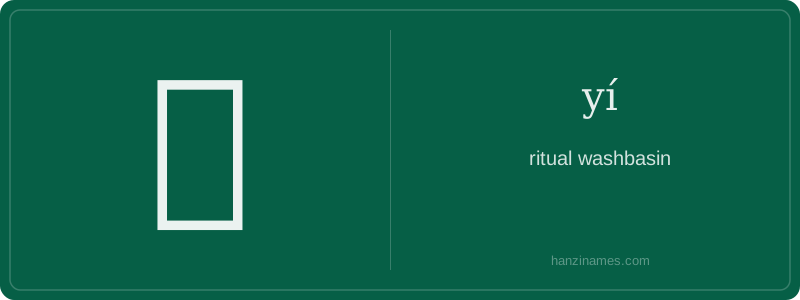
匜 is virtually absent from modern spoken or written Chinese outside academic, museum, or antique contexts. It appears in archaeological reports, museum labels (e.g., 'Western Zhou bronze yí'), and classical texts like the Rites of Zhou (Zhou Li), where it is prescribed for ritual ablutions. No idioms or colloquial phrases contain 匜—it is not used in HSK vocabulary, nor taught in standard language curricula. Its survival is purely historical and lexical, confined to specialized discourse on ancient material culture.
The character is a documented bronze script (jinwen) pictograph: its oracle-bone precursors are unattested, but early Western Zhou inscriptions show a clear side-view outline—oval basin, upward-curving spout, and arched handle. This visual fidelity confirms it as one of Chinese writing’s most direct artifact-to-character translations—no metaphor, no abstraction, just bronze made ink.
As an archaeologist sifting through Zhou dynasty bronze workshops, I first encountered 匜 in the damp earth of Shaanxi—its elegant, curved silhouette cast in green patina, unmistakably a ritual vessel. Unlike utilitarian basins, this was ceremonial: a graceful, oval-shaped basin with a single tubular spout and a looped handle, designed for pouring water during ancestral rites and purification ceremonies. Its form speaks of intentionality—not mere function, but symbolic flow: water as conduit between human and divine.
Excavations at Guo State cemetery (c. 7th century BCE) revealed 匜 consistently paired with 盨 (xǔ), a covered food vessel—evidence of the ‘water-and-grain’ duality central to Zhou ritual hygiene. Inscriptions on some 匜 name aristocratic donors, linking the vessel to lineage prestige. The character’s earliest attested form appears in bronze script (jinwen), where it clearly depicts the vessel’s profile: basin, spout, and handle—no abstraction, only faithful observation.
What fascinates me is how 匜 preserves a vanished choreography: the precise hand motion of lifting, tilting, and pouring purified water over hands before sacrifice—a gesture erased from daily life but fossilized in script. Unlike later characters that evolved into phonetic-semantic compounds, 匜 remains a rare, intact pictograph—its shape unchanged across three millennia of writing evolution. It doesn’t just name a thing; it reenacts the gesture of reverence itself.
Example Sentences
Common Compounds
Similar Characters — Don't Mix These Up
Your First Step into Chinese Culture: Get a Chinese Name
Every journey into Chinese begins with a name. Use our free Chinese name generator to create a meaningful, personalized Chinese name that fits you perfectly.
Get My Chinese Name →