匝
Character Story & Explanation
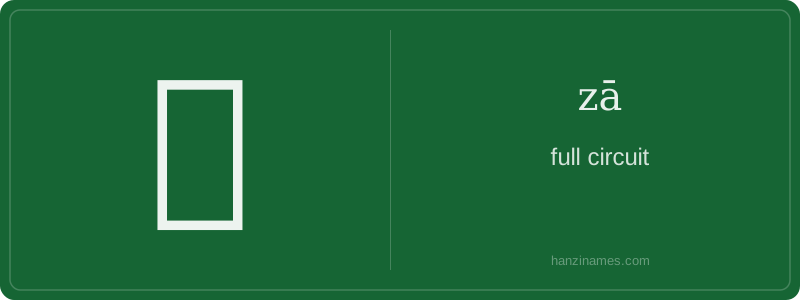
匝 is rarely used alone in modern Mandarin but appears in precise technical and literary contexts. It’s standard in engineering and physics for measuring coil turns (e.g., 一匝线圈, 'one-turn coil') and in surveying for full rotations (e.g., 地磁匝数, 'magnetic flux linkage in webers'). Historically, it appears in classical texts like the Book of Rites (Liji) describing ritual circumambulation (‘三匝而止’, 'three circuits and then stop'), reflecting ceremonial completeness. It also occurs in Tang poetry describing celestial motion.
The character’s form is not pictographic but phono-semantic: the radical 匚 denotes enclosure, while the phonetic component 帀 (an archaic form of 币, originally depicting a round coin or jade disc) provides sound and hints at circular shape. No oracle bone or bronze script forms survive for 匝—it first appears reliably in Han dynasty clerical script, likely created to express the abstract concept of 'full circuit' in technical and ritual discourse.
The character 匝 (zā) embodies a subtle yet profound aspect of the Chinese worldview: the significance of boundary, return, and cyclical completeness. Unlike Western notions that often privilege linear progress, 匝 reflects a cultural sensitivity to enclosure—not as confinement, but as intentional containment, ritual framing, or rhythmic recurrence. Its radical 匚 (a 'box' or 'enclosure') signals spatial definition, while the internal component 帀 (a variant of 币, originally depicting a round coin) subtly evokes circularity and wholeness—suggesting that encircling is not mere repetition, but a meaningful completion.
This character reveals how classical Chinese thought perceives motion not only as directional movement but as purposeful orbit—like the heavens revolving around the pole star, or rituals performed in full circuit. In Daoist and Confucian cosmology, ‘going around’ implies alignment with natural cycles: seasons, breath, celestial bodies. To ‘encircle’ is thus to harmonize—to place oneself within a coherent, bounded order where every turn has moral or cosmic resonance, not just physical location.
Even today, 匝 carries quiet philosophical weight: when engineers measure ‘turns per second’ (转/匝), or when poets write of ‘one full circuit of sorrow’, the character anchors abstraction in embodied geometry. It reminds us that in Chinese thinking, meaning often emerges at the threshold—between inside and outside, beginning and end, motion and rest. Encircling isn’t escape from linearity; it’s the deliberate act of returning to origin with new understanding—a loop that closes not to end, but to renew.
Example Sentences
Common Compounds
Similar Characters — Don't Mix These Up
Your First Step into Chinese Culture: Get a Chinese Name
Every journey into Chinese begins with a name. Use our free Chinese name generator to create a meaningful, personalized Chinese name that fits you perfectly.
Get My Chinese Name →