匸
Character Story & Explanation
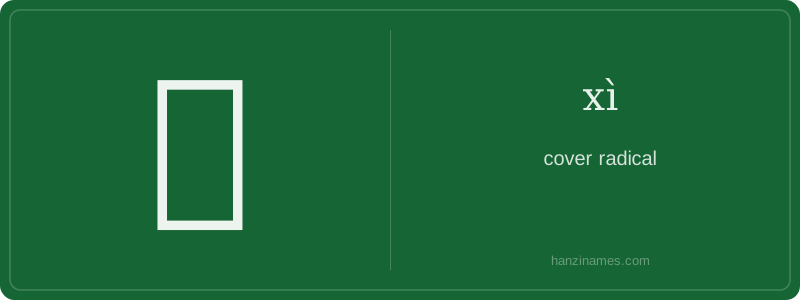
匸 is not used independently in modern Mandarin—it has no standalone pronunciation in daily speech and does not appear in dictionaries as an independent word. Instead, it functions exclusively as a Kangxi radical (Radical 23), appearing in 29 characters in the Kangxi Dictionary, primarily those implying enclosure, division, or concealment. Its documented role is structural, not lexical: it serves as a semantic classifier in characters like 区 (qū, 'district') and 匹 (pǐ, 'a bolt of cloth'), both historically tied to measured, bounded units.
The character’s earliest attested form appears in seal script (c. 3rd century BCE), where it resembles a curved barrier enclosing space—consistent with Xu Shen’s definition in Shuowen Jiezi as 'to cover, to conceal'. It is not a pictograph of a physical object, but an ideographic abstraction of containment, verified by paleographic analysis of Warring States bamboo texts and Han dynasty inscriptions.
As an archaeologist brushing dust from a Han dynasty bamboo slip, I find 匸 not as a standalone word—but as a silent guardian in the structure of characters. Its two strokes—a downward curve followed by a horizontal sweep—form a minimalist enclosure, like a low wall or a folded cloth drawn over something precious. This radical appears in characters related to concealment, protection, or containment: 区 (qū, 'region'), 匹 (pǐ, 'a piece of cloth'), and 匠 (jiàng, 'craftsman'—one who shapes and encloses form). Its simplicity belies its semantic weight: it is architecture in microcosm.
Excavating deeper into Shuowen Jiezi (121 CE), Xu Shen classifies 匸 as a ‘zhǐshì’ (indicative) character—designed not to depict an object literally, but to suggest an abstract idea: the act of covering or shielding. Unlike pictographs such as 日 (sun) or 山 (mountain), 匸 communicates function over form. It evokes intentionality: something deliberately hidden, not lost. Its presence in compound characters signals that meaning is bounded—contained within limits, whether spatial, conceptual, or ritual.
This radical rarely stands alone in modern usage, yet its ghost lingers in every enclosed space implied by Chinese script. When we see the top of 医 (yī, 'medicine'), the left of 匝 (zā, 'to encircle'), or the frame of 匠, we encounter 匸’s ancient logic: safety lies in containment; meaning emerges through boundary. As excavators of language, we realize that some of the most powerful elements in Chinese writing are not nouns or verbs—but the quiet, two-stroke walls that hold them together.
Example Sentences
Common Compounds
Similar Characters — Don't Mix These Up
Your First Step into Chinese Culture: Get a Chinese Name
Every journey into Chinese begins with a name. Use our free Chinese name generator to create a meaningful, personalized Chinese name that fits you perfectly.
Get My Chinese Name →