匽
Character Story & Explanation
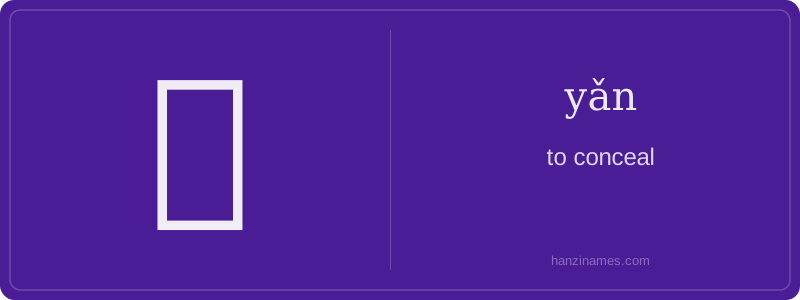
匽 is exceptionally rare in modern daily use and does not appear in any HSK level (HSK 1–9). It occurs almost exclusively in classical texts, historical hydraulics terminology (e.g., 匽潦, yǎn lǎo, 'concealed drainage'), and pre-Qin medical writings. No idioms or common phrases containing 匽 exist in contemporary Mandarin; it is absent from the Xiandai Hanyu Cidian and major corpora like BCC or SUBTLEX. Its usage is strictly scholarly or textual-archaeological.
The character’s structure is clearly phono-semantic: radical 匸 (xì, 'to hide, to enclose') + phonetic 奄 (yǎn, indicating pronunciation and reinforcing meaning—奄 itself means 'to cover suddenly' or 'to suppress'). This composition is documented in the Shuōwén Jiězì (121 CE), which defines 匽 as 'to hide, to conceal' (匿也), confirming its functional, spatial semantics—not pictographic, but logographic with deliberate enclosure logic.
As an archaeologist brushing dust from a Han dynasty bamboo slip, I find 匽 not etched in oracle bone but inscribed in quiet urgency—its form a sealed chamber: the radical 匸 (xì), meaning 'to conceal', cradles the phonetic component 奄 (yǎn), evoking suppression, breath held mid-inhalation. This isn’t a character for open action—it’s for what slips beneath notice: withheld words, suppressed emotions, hidden infrastructure.
Excavating later texts reveals 匽 as a semantic anchor in classical medical and philosophical manuscripts. In the Huangdi Neijing, it describes how pathogenic qi ‘hides’ (匽) in the zang-fu organs before erupting as illness. Its nine strokes—precise, contained—mirror ritual containment: no flourish, no escape. The top horizontal stroke seals the enclosure like a tomb lid; the final dot is a silent period at the end of a suppressed thought.
Unlike flashier characters, 匽 survives not in slogans or poetry, but in technical registers: hydraulics, medicine, and bureaucratic euphemism. Its rarity today reflects linguistic sedimentation—what was once vital (e.g., concealing waste in ancient latrines) became obsolete, then archaic. Yet its semantic DNA persists in compounds where ‘concealment’ is functional, not metaphorical: hiding water flow, repressing data, sequestering emotion. It is the archaeology of restraint made visible.
Example Sentences
Common Compounds
Similar Characters — Don't Mix These Up
Your First Step into Chinese Culture: Get a Chinese Name
Every journey into Chinese begins with a name. Use our free Chinese name generator to create a meaningful, personalized Chinese name that fits you perfectly.
Get My Chinese Name →