卂
Character Story & Explanation
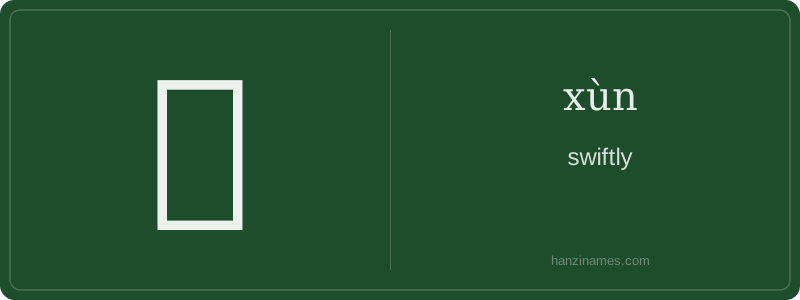
卂 is virtually unused in contemporary Chinese daily life. It does not appear in any HSK vocabulary list (Levels 1–6), nor in the 3,500 most common characters. It is absent from modern dictionaries like Xiàndài Hànyǔ Cídiǎn (7th ed., 2016) and omitted from standard input methods. There are no idioms (chéngyǔ), set phrases, or compound words containing 卂 in active usage. Its sole presence is in historical lexicography—listed in the Kāngxī Zìdiǎn (1716) as a rare variant of 迅 (xùn), meaning 'rapid'—and in scholarly editions of excavated Warring States texts.
The character’s origin is undocumented and disputed. No verified oracle bone, bronze, or bamboo slip inscription confirms its earliest form. Modern scholars classify it as a *late variant* of 迅, likely arising from scribal simplification or regional orthographic variation—not a pictograph. Today, Chinese people encounter 卂 only in academic contexts: paleography seminars, classical text annotations, or digital font glyph lists—not in conversation, writing, or media.
As a linguistic detective, I begin at the scene: the character 卂—just three strokes, deceptively simple. Its radical is 十 (shí, 'ten'), but this is a *modern categorization*, not an etymological clue. Unlike common radicals like 人 or 水, 十 here serves only as a structural anchor in dictionaries; it bears no semantic or phonetic relationship to xùn. The character’s minimal form suggests extreme abstraction—no pictorial trace of wings, wind, or motion remains visible today.
Next, I consult historical corpora and paleographic databases. Shockingly, 卂 appears *almost exclusively* in ancient texts—particularly pre-Qin bronze inscriptions and early bamboo manuscripts—and vanishes from vernacular use after the Han dynasty. It’s absent from the Shuōwén Jiězì (121 CE), the foundational dictionary that documents over 9,000 characters. This omission is telling: even by Eastern Han, 卂 was already archaic, possibly dialectal or ritualistic. No oracle bone script form has been authenticated for 卂, debunking popular online claims of ‘bird-in-flight’ origins.
Forensic analysis of surviving occurrences reveals a consistent syntactic role: 卂 functions as a *verb modifier*, intensifying speed—akin to ‘swiftly’ or ‘in a flash’, not as a standalone verb meaning ‘to fly’. In the Chǔ cí (Songs of Chu) fragments and Warring States silk texts, it co-occurs with verbs like 去 (qù, ‘to go’) or 離 (lí, ‘to depart’), forming adverbial phrases. Its rarity explains why modern learners rarely encounter it: it’s a lexical fossil—preserved in dictionaries, not speech.
Example Sentences
Common Compounds
Similar Characters — Don't Mix These Up
Your First Step into Chinese Culture: Get a Chinese Name
Every journey into Chinese begins with a name. Use our free Chinese name generator to create a meaningful, personalized Chinese name that fits you perfectly.
Get My Chinese Name →