卄
Character Story & Explanation
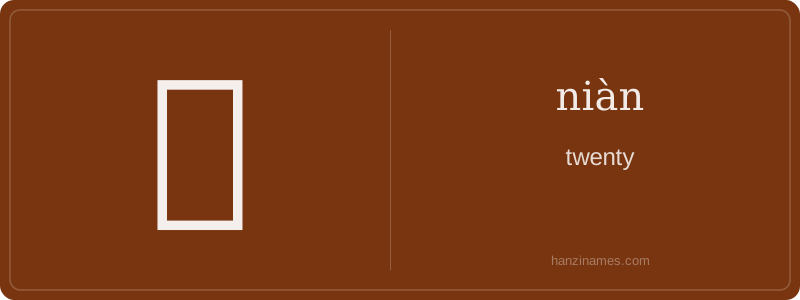
卄 is virtually obsolete in modern Mandarin usage; it appears only in classical texts, antique seals, calligraphy collections, and occasionally in artistic or poetic contexts to evoke antiquity or elegance. It is absent from all HSK vocabulary lists and contemporary textbooks. No standard idioms or fixed phrases contain 卄 in modern usage—its role is purely historical and aesthetic, not functional.
The character is a cursive/abbreviated form of 二十, documented in Song- and Ming-dynasty calligraphic manuals and epigraphic rubbings. It evolved from handwritten simplification—not an oracle-bone or bronze script pictograph—but a practical shorthand used by literati scribes who valued speed and grace over strict orthographic uniformity.
卄 (niàn) is a rare but elegant archaic variant of 二十 (èrshí, 'twenty'), embodying the Chinese cultural reverence for numerical concision and calligraphic economy. Its three-stroke form—two horizontal lines flanking a central vertical stroke—mirrors the philosophical ideal of balance: the top and bottom strokes represent heaven and earth, while the central line symbolizes humanity mediating between them, echoing the Confucian 'Three Powers' (Heaven, Earth, Humanity).
This character reflects how classical Chinese thinkers encoded cosmology into script: 十 (shí, 'ten') is the foundational unit of completeness, and doubling it—visually compressed into 卄—signifies abundance without excess. Unlike Western numerals, which prioritize linear progression, 卄 conveys relational harmony: twenty is not merely 2 × 10, but a threshold where cyclical time (e.g., lunar decades) meets human ritual structure.
In imperial China, 卄 appeared in inscriptions, poetry, and scholarly seals—not as everyday arithmetic, but as a marker of refined literacy and temporal awareness. Its scarcity today underscores a broader cultural truth: meaning in Chinese writing often resides not just in denotation, but in stylistic choice, historical resonance, and the quiet dignity of restraint.
Example Sentences
Common Compounds
Similar Characters — Don't Mix These Up
Your First Step into Chinese Culture: Get a Chinese Name
Every journey into Chinese begins with a name. Use our free Chinese name generator to create a meaningful, personalized Chinese name that fits you perfectly.
Get My Chinese Name →