卅
Character Story & Explanation
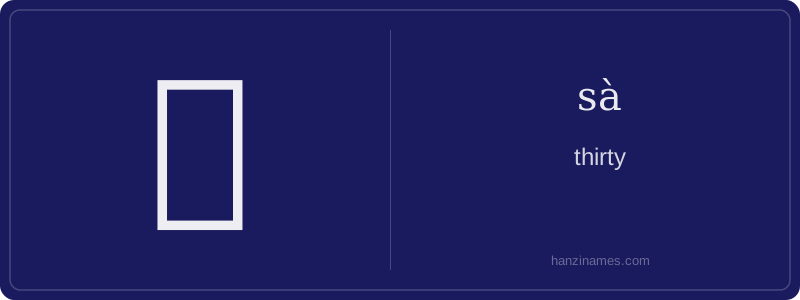
卅 appears primarily in historical, literary, or stylistic contexts — never in everyday speech or beginner textbooks. You’ll find it in classical poetry, pre-20th-century documents, and occasionally in modern calligraphy or brand names evoking tradition (e.g., ‘卅年’ on anniversary logos for 30-year-old companies). It’s also used in formal financial writing in Taiwan and Hong Kong as a fraud-resistant alternative to 三十 — similar to how English uses 'XXX' or 'thirty' instead of '30' on checks.
The character evolved from seal script, where it represented a ligatured form of 三十 — not a pictograph, but a cursive simplification. By the Han dynasty, 卅 was standardized as a single-character numeral for thirty in bamboo-slip records and stone inscriptions. Its form reflects practical handwriting efficiency, not natural imagery.
Hello students! Today we’ll explore 卅 (sà), a compact, elegant character meaning 'thirty'. Though rarely used in modern spoken Mandarin, it’s an important written numeral with deep historical roots. It’s composed of just four strokes and shares the 十 (shí, 'ten') radical — showing its numerical kinship. Don’t confuse it with 三十 (sānshí); 卅 is a *single-character abbreviation*, like a shorthand symbol you might see on old calendars or formal documents.
This character belongs to classical Chinese numerals — alongside 卅 (30), 卌 (40), and 卌 (also 40, variant), and 皕 (bì, 200). While not in the HSK syllabus (no official HSK level assigned), recognizing 卅 helps you read historical texts, antique inscriptions, and even some traditional shop signs or calligraphy works. Its simplicity makes it a great stroke-order practice piece!
Writing 卅 correctly matters: start with the top horizontal stroke, then the left vertical, followed by the right vertical, and finish with the short connecting stroke at the bottom — all in one fluid motion. Though it looks like two 十 characters stacked, it’s actually a fused, stylized form of 三十. Think of it as 'ten three times' — but condensed into one glyph. Mastering it builds confidence in reading older or artistic Chinese.
Example Sentences
Common Compounds
Similar Characters — Don't Mix These Up
Your First Step into Chinese Culture: Get a Chinese Name
Every journey into Chinese begins with a name. Use our free Chinese name generator to create a meaningful, personalized Chinese name that fits you perfectly.
Get My Chinese Name →