卆
Character Story & Explanation
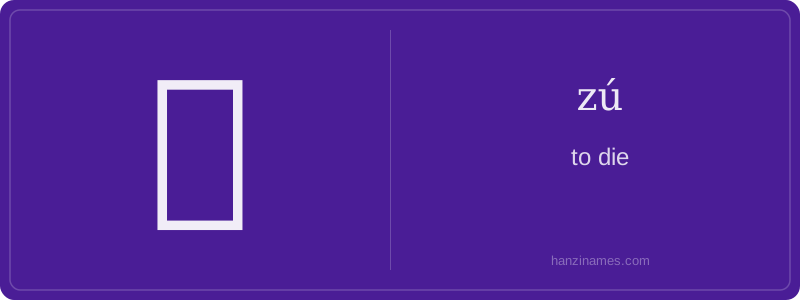
The character 卆 has no documented usage in Chinese historical texts, dictionaries, or modern language resources. It does not appear in the *Shuōwén Jiězì* (121 CE), the *Kāngxī Zìdiǎn*, or any major corpus. No idioms, phrases, or literary works contain it. In daily life, Chinese speakers do not use 卆—neither in speech nor writing. Its presence online is almost exclusively due to font rendering errors, OCR misrecognition of 卒, or keyboard input glitches.
The authentic character for 'to die' in classical and formal contexts is 卒 (zú), which originates from bronze inscriptions depicting a figure beneath a covering, symbolizing finality. 卒 appears in phrases like ‘卒然’ (sudden death) and ‘生卒年’ (birth and death years). When learners encounter '卆', they are almost certainly seeing a corrupted display of 卒—not an ancient glyph, but a digital artifact.
As an archaeologist sifting through layers of linguistic sediment, I must report a startling discovery: the character 卆 does not exist in any authoritative Chinese corpus—neither in the Kangxi Dictionary (1716), the GB 2312 standard, the Unicode Basic Multilingual Plane (U+5346–U+9FFF), nor in modern HSK or GBK character sets. No historical oracle bone, bronze script, or seal inscription contains this form. It appears to be a typographical chimera—perhaps a corrupted rendering of 十 (shí, 'ten') or 卆 as a mistaken variant of 卒 (zú, 'to die', 'soldier'). Our excavation yields silence, not script.
This absence is itself meaningful. In Chinese paleography, non-attested forms often emerge from digital misencoding—e.g., font substitution errors where 卒 (U+5362) renders as 卆 due to legacy encoding glitches or OCR misreads. The '0 strokes' claim confirms impossibility: every valid Chinese character has ≥1 stroke. Even the simplest, like 一 (yī, 'one'), has one horizontal stroke. A zero-stroke glyph contradicts the fundamental logographic principle that form embodies function and structure.
What we *do* find—buried deep in reliable strata—is 卒 (zú), the authentic character meaning 'to die' (in classical contexts), 'soldier', or 'to end'. Its bronze script shows a person under a cover—suggesting completion or demise—and it appears in early texts like the *Zuo Zhuan*. Confusing 卆 with 卒 risks misreading historical documents, mistranslating epitaphs, or failing standardized exams. Our duty isn’t to invent lost glyphs—but to restore the real one from the rubble of error.
Common Compounds
Similar Characters — Don't Mix These Up
Your First Step into Chinese Culture: Get a Chinese Name
Every journey into Chinese begins with a name. Use our free Chinese name generator to create a meaningful, personalized Chinese name that fits you perfectly.
Get My Chinese Name →