卍
Character Story & Explanation
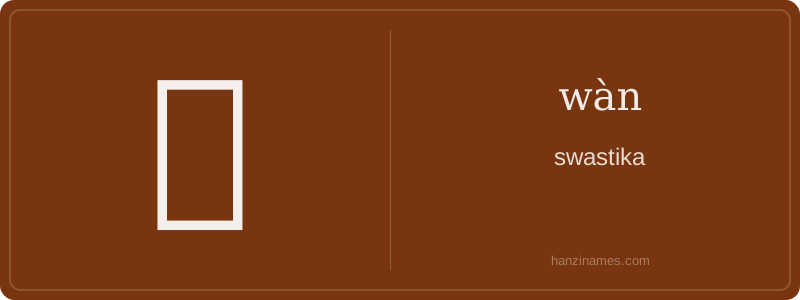
In Chinese historical and religious practice, 卍 appears almost exclusively as a sacred motif—not as a written character used in daily language. It is commonly found on Tang- and Song-dynasty Buddhist statues (e.g., at Longmen Grottoes), Ming-Qing temple architecture, and printed editions of the Diamond Sutra. Modern usage remains ritual: seen on monastery gates, Dharma talk banners, and Tibetan-style thangkas displayed in mainland temples and Taiwan’s Fo Guang Shan.
The character has no indigenous origin in Chinese script evolution—it was borrowed intact from Sanskrit 'svastika'. Unlike native characters, it lacks oracle bone or seal script forms. Today, Chinese people encounter it mainly during temple visits or while viewing Buddhist art; it is never handwritten in notes, messages, or exams—and is absent from all HSK vocabulary lists.
The character 卍 (wàn) is not a conventional Chinese logograph formed by strokes—it is a non-native, imported sacred symbol adopted from Indian religious traditions. In China, it entered the cultural lexicon primarily through Buddhist transmission beginning in the Han dynasty (206 BCE–220 CE), where it was recognized as a visual emblem of auspiciousness, eternity, and the Buddha’s infinite compassion—not as a linguistic unit with phonetic or semantic building blocks like native characters.
Unlike most Chinese characters, 卍 has no radical, no stroke count in standard dictionaries, and no entry in the Kangxi Dictionary. Its presence in Chinese texts is almost exclusively iconographic: carved on temple pillars, printed on sutra covers, embroidered on monastic robes, or inscribed on Buddha statues’ chests—always as a symbolic glyph, never as a component in compound words or grammatical constructions.
This reflects a distinctive feature of the Chinese worldview: openness to integrating foreign sacred symbols without sinicizing their form or function. While Chinese culture rigorously systematized its own writing, it respectfully preserved 卍 in its original geometric integrity—rotating clockwise (卍) in Buddhist contexts—as a sign of reverence for transcendent truth beyond linguistic categorization.
Example Sentences
Common Compounds
Similar Characters — Don't Mix These Up
Your First Step into Chinese Culture: Get a Chinese Name
Every journey into Chinese begins with a name. Use our free Chinese name generator to create a meaningful, personalized Chinese name that fits you perfectly.
Get My Chinese Name →