卐
Character Story & Explanation
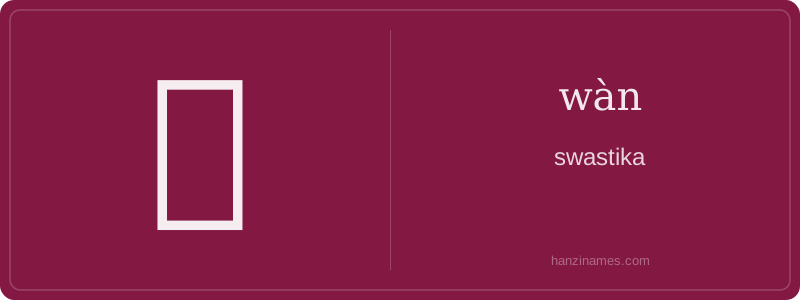
In contemporary China, 卐 is almost never used as a written character in daily language. It appears exclusively in religious, academic, or artistic contexts: Buddhist temple architecture (e.g., carved on pillars at Shaolin Monastery), scholarly publications on Indian religions, or museum exhibits about Silk Road Buddhism. It is absent from HSK lists, textbooks, and digital input methods—not due to taboo, but because it functions as a sacred symbol, not a functional Chinese character.
The form 卐 has no origin in Chinese script evolution (it’s not found in oracle bones, bronze inscriptions, or seal script). It was adopted as a phonetic-ideographic loan from Sanskrit 'svastika' via Buddhist translation. Today, Chinese people encountering it do so in temples or documentaries—not in texting or signage—and recognize it solely as a Buddhist emblem, never as a word meaning 'ten thousand' or carrying independent lexical weight.
As an archaeologist sifting through Dunhuang manuscripts and Tang-dynasty temple murals, I first encountered 卐 not as a glyph in a dictionary—but as a radiant motif carved into the halo of a Bodhisattva’s head at Mogao Cave 220. Its arms spin clockwise—a ‘right-facing’ swastika (卐), distinct from the left-facing version (卍) used in some East Asian Buddhist texts. This isn’t mere decoration: it’s a ritual cipher for eternity, cosmic order, and the Buddha’s footprints—literally stamped into stone thresholds of Nalanda and Longmen.
The character appears in over 200 Sanskrit-to-Chinese Buddhist translations from the 2nd–10th centuries, consistently transcribed as wàn (‘ten thousand’) to evoke boundlessness—not numeric literalism, but metaphysical plenitude. Xuanzang’s 7th-century translation of the *Mahāparinirvāṇa Sūtra* explicitly defines 卐 as ‘the mark of the Buddha’s auspiciousness’ (佛吉祥相), linking it to the 32 major marks of a great being. Its symmetry mirrors mandala logic: no beginning, no end, only dynamic continuity.
Crucially, this symbol predates its 20th-century Western appropriation by millennia—and in Chinese contexts, it carries zero association with that distortion. Inscriptions on Song-dynasty bronze incense burners, Ming sutra-printing blocks, and Qing-era Tibetan Buddhist thangkas all preserve 卐 as a sacred grapheme—not a logograph with semantic content like ‘virtue’ or ‘peace’, but a non-lexical, ritual sign. Its silence in modern dictionaries reflects this: it’s not ‘used’ linguistically, but venerated iconographically.
Example Sentences
Common Compounds
Similar Characters — Don't Mix These Up
Your First Step into Chinese Culture: Get a Chinese Name
Every journey into Chinese begins with a name. Use our free Chinese name generator to create a meaningful, personalized Chinese name that fits you perfectly.
Get My Chinese Name →