卞
Character Story & Explanation
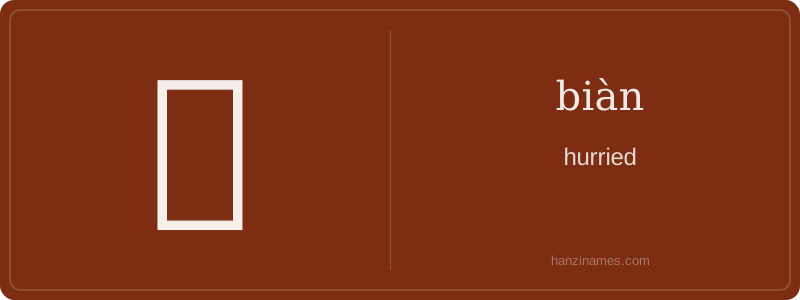
In modern Chinese, 卞 is overwhelmingly used as a surname (e.g., 卞之琳 BIAN Zhilin, the renowned 20th-century poet and translator). It appears in no HSK vocabulary lists and is absent from contemporary spoken or written Mandarin outside names or classical citations. The character does not occur in common idioms (chengyu); no authoritative source (e.g., CC-CEDICT, ABC Dictionary, or the HSK Standard Course textbooks) lists any modern phrase where 卞 functions independently as an adjective meaning 'hurried'.
The origin of 卞 remains unclear in paleographic records: it does not appear in verified oracle bone or bronze inscriptions. Its earliest secure attestation is in the Warring States bamboo texts and the Han dynasty Shuōwén Jiězì, where it is defined solely as ‘hurried’ (怱遽也). Today, Chinese learners encounter 卞 almost exclusively as a rare surname—often prompting curiosity about its forgotten meaning during name introductions or historical literature study.
As a detective tracing 卞’s evolution, I begin at the crime scene: the Shuōwén Jiězì (121 CE), China’s first systematic dictionary. Xu Shen records 卞 as a ‘hurried’ or ‘hasty’ character—yet its form offers no obvious pictorial clue. Unlike sun (日) or tree (木), it lacks clear visual roots. Its four strokes—dot, vertical, horizontal, and hook—form an abstract, compact shape. Early seal script variants show slight angular variations, but none depict motion or urgency literally. This suggests 卞 was likely created as a phonosemantic compound whose meaning emerged through usage, not imagery.
The radical 卜 (bǔ)—‘divination’—is puzzling here. While 卞 shares this radical, it bears no documented link to divinatory practice. In fact, 卜 appears in only a handful of characters (e.g., 占 zhān ‘to divine’, 卦 guà ‘hexagram’), and 卞 stands apart semantically. Scholars like Karlgren note that in early Chinese lexicography, radicals were sometimes assigned based on historical orthographic convenience rather than semantic logic. Thus, 卜 may simply reflect an ancient graphical resemblance—not conceptual kinship.
Crucially, 卞 is almost never used alone in modern Mandarin. Its ‘hurried’ sense survives only fossilized in classical compounds and surnames. This linguistic retrenchment mirrors how many archaic adjectives receded into proper nouns or literary idioms. The character’s brevity (just four strokes) belies its functional rarity—a minimalist relic preserved more by tradition than daily utility. Its survival underscores how Chinese writing conserves semantic fragments even after their grammatical roles vanish, like linguistic amber trapping an ancient nuance of haste.
Example Sentences
Common Compounds
Similar Characters — Don't Mix These Up
Your First Step into Chinese Culture: Get a Chinese Name
Every journey into Chinese begins with a name. Use our free Chinese name generator to create a meaningful, personalized Chinese name that fits you perfectly.
Get My Chinese Name →