卣
Character Story & Explanation
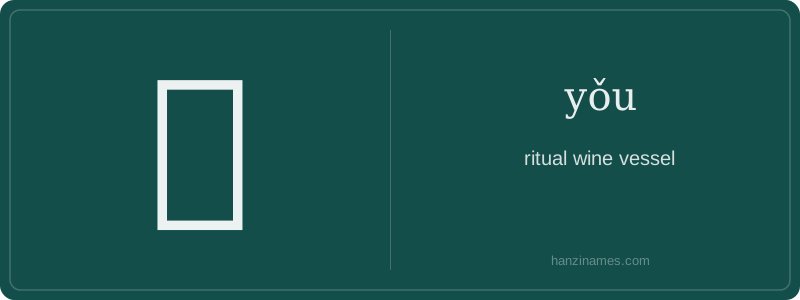
卣 (yǒu) appears almost exclusively in academic, museum, and antiquarian contexts today—never in modern spoken Mandarin or everyday writing. It occurs in archaeological reports (e.g., '商代青铜卣', Shāng-dài qīngtóng yǒu), museum labels, and classical poetry referencing ancient rites. No idioms or colloquial phrases contain 卣; it has no place in HSK vocabulary lists or textbooks, reflecting its complete functional obsolescence outside specialized domains.
The character is a verified pictograph: oracle-bone script forms (c. 1200 BCE) clearly depict a lidded wine vessel with a curved body and chain-connected lid—matching excavated bronzes. Later seal script standardized the form into its current 7-stroke structure, preserving the lid (⺊), body (冂-like curve), and base (一 + 丿). No scholarly dispute exists about its origin—it is among the best-attested pictographic characters in early Chinese writing.
As an archaeologist brushing dust from a Shang dynasty bronze hoard in Anyang, I first encountered 卣 (yǒu) not as a character—but as a vessel: a squat, lidded wine container with looping handles and taotie masks. Its form is unmistakable—curved belly, flared mouth, often with a chain linking lid to handle. This wasn’t mere pottery; it was ritual technology, used in ancestral sacrifices where wine mediated between human and divine realms.
The character 卣 emerged directly from this object. Oracle-bone and bronze inscriptions show a highly stylized pictograph: the top stroke represents the lid, the central curve the bulging body, and the lower strokes the base and foot—sometimes even hinting at the suspension chain. Unlike abstract radicals, 卣 is one of Chinese writing’s most faithfully preserved pictographs, retaining its Bronze Age silhouette across three millennia.
Its radical ⺊ (the ‘cover’ or ‘lid’ component) anchors its semantic field—not merely ‘container’, but specifically a *ritual* vessel with a sealed, sacred interior. This distinguishes it from generic containers like 壶 (hú) or 瓶 (píng). Though obsolete in daily use, 卣 survives as a lexical fossil in archaeology, museology, and classical texts—where every occurrence signals elite ritual practice, not casual drinking. Its seven strokes are a compact archaeogram: each stroke a deliberate echo of bronze-caster’s craft.
Example Sentences
Common Compounds
Similar Characters — Don't Mix These Up
Your First Step into Chinese Culture: Get a Chinese Name
Every journey into Chinese begins with a name. Use our free Chinese name generator to create a meaningful, personalized Chinese name that fits you perfectly.
Get My Chinese Name →