卩
Character Story & Explanation
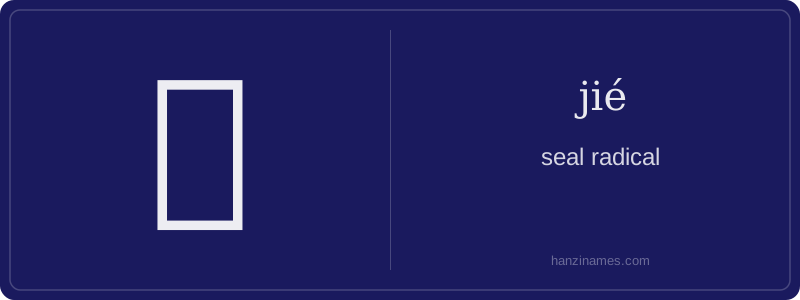
Historically, 卩 appears in bronze inscriptions and early seal scripts as part of characters denoting official acts — especially in bureaucratic contexts of the Zhou and Qin dynasties. While never used alone in classical texts, it consistently served as a semantic component in characters related to command, authorization, or ritual submission. In modern usage, 卩 survives exclusively as a radical — most visibly in printed dictionaries and Unicode fonts under the name 'seal radical' (U+5369). You’ll encounter it in formal documents, calligraphy guides, and character etymology resources — never in spoken Mandarin or casual writing.
The earliest attested form (c. 1000 BCE) resembles a kneeling figure with hands clasped, reflecting ancient rites of pledging allegiance or receiving mandates. Archaeological evidence from Shang oracle bones shows similar postures in divinatory records involving royal decrees — confirming its association with sanctioned action, not mere 'sealing' as in stamping ink.
Hello students! Today we’ll explore 卩 (jié), a tiny but powerful character — just two strokes, yet deeply rooted in China’s administrative and cultural history. It’s not commonly used alone today, but it appears as a radical in many important characters like 即 (jí, 'immediately'), 却 (què, 'yet, however'), and 卿 (qīng, an ancient honorific). Think of 卩 as a silent guardian of meaning — it often hints at official authority, formal action, or ritualized behavior.
This character originally depicted a kneeling person receiving or presenting a token — likely a ceremonial seal or tally. In ancient China, such tokens verified identity or authorized actions, much like modern ID cards or digital signatures. Though 卩 is no longer an independent word in daily speech, its presence in compound characters subtly reinforces ideas of legitimacy, immediacy, and procedural correctness.
As learners, don’t worry about memorizing 卩 as a standalone vocabulary item — it’s not in the HSK lists at any level because it doesn’t function independently in modern Mandarin. Instead, treat it as a key to unlocking deeper understanding: when you see 卩 on the right side of a character (e.g., 即), pause and ask, 'What kind of formal or authoritative action might this imply?' That habit builds real character intuition.
Example Sentences
Common Compounds
Similar Characters — Don't Mix These Up
Your First Step into Chinese Culture: Get a Chinese Name
Every journey into Chinese begins with a name. Use our free Chinese name generator to create a meaningful, personalized Chinese name that fits you perfectly.
Get My Chinese Name →