卵
Character Story & Explanation
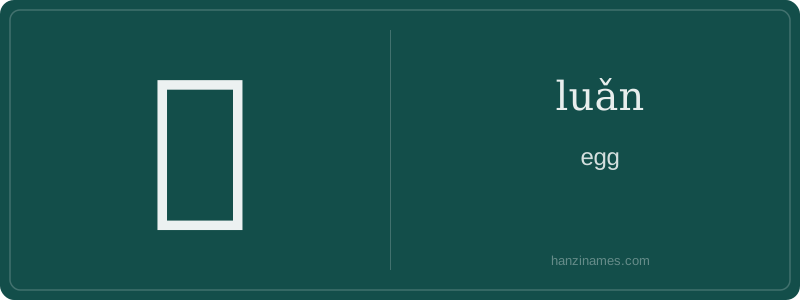
In modern Chinese, 卵 is widely used in scientific, culinary, and colloquial registers: biologists say 卵细胞 (luǎn xìbāo, 'ovum'), chefs refer to 鱼卵 (yú luǎn, 'fish roe'), and idioms like 卵与石斗 (luǎn yǔ shí dòu, 'egg against stone') appear in classical allusions and modern political commentary to denote hopeless confrontation. The phrase 鸡蛋 (jīdàn) dominates daily speech for 'chicken egg', while 卵 is reserved for formal or technical contexts—confirming its lexical specialization.
The character’s origin is not pictographic—it does not visually replicate an egg. Instead, its earliest attested forms (Warring States bamboo slips) show a top component resembling a covered vessel and 卩 below, supporting the theory that it evolved as a phono-semantic compound, not a direct drawing. Today, Chinese learners encounter it most often in HSK 4+ biology lessons or food labels for caviar and fertilized eggs.
Our investigation begins with the oracle bone and bronze inscriptions—yet 卵 (luǎn) is notably absent from the earliest extant scripts. It first appears reliably in the Warring States bamboo texts and Han dynasty seal script, suggesting it emerged as a more specialized term after the foundational pictographs were standardized. Its form doesn’t mimic an egg’s oval shape directly; instead, scholars trace its structure to a semantic-phonetic compound: the radical 卩 (jié), historically linked to ‘kneeling figures’ or ‘seals’, likely repurposed here for phonetic support, paired with a simplified pictorial element evoking containment—perhaps a shell encasing life.
The character’s seven-stroke composition reveals deliberate economy: the top two strokes suggest enclosure (like a lid or membrane), the middle horizontal bar implies division or yolk, and the lower 卩 grounds it in the body of written Chinese—not as a standalone pictogram, but as a calibrated logograph built for precision in medical, biological, and culinary contexts. This reflects how Classical Chinese expanded vocabulary not through new pictographs, but by recombining existing elements with semantic nuance.
Unlike characters such as 日 (rì, 'sun') or 木 (mù, 'tree'), 卵 carries no mythic or cosmological baggage in early texts. Its emergence coincides with advances in agronomy and medicine—Han dynasty texts like the *Huangdi Neijing* discuss ‘egg yin’ in physiological theory, and agricultural manuals list egg-laying cycles of poultry and silkworms. Thus, 卵 entered the lexicon not as poetic symbol, but as a technical term—evidence of China’s early empirical approach to biology and food science.
Example Sentences
Common Compounds
Similar Characters — Don't Mix These Up
Your First Step into Chinese Culture: Get a Chinese Name
Every journey into Chinese begins with a name. Use our free Chinese name generator to create a meaningful, personalized Chinese name that fits you perfectly.
Get My Chinese Name →