恤
Character Story & Explanation
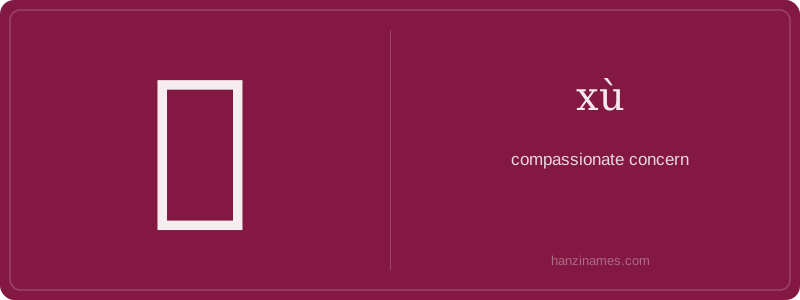
恤 is predominantly used in formal, written Chinese—not daily conversation. It appears in idioms like 恤老怜贫 (xù lǎo lián pín), meaning 'to care for the elderly and pity the poor', cited in Ming-Qing dynasty charitable ordinances and still invoked in official welfare discourse. Modern media uses it in headlines like '政府恤民政策' ('government policies caring for the people'), emphasizing state responsibility. It’s also found in legal and medical contexts: '恤刑' (xù xíng) refers to leniency in sentencing based on mitigating circumstances—a documented judicial principle since the Tang Code.
The character is not pictographic. Its earliest attestation is in seal script (c. 3rd century BCE), combining 忄 (heart radical) with 血 (blood) as a phonetic component—though pronunciation diverged over time. No oracle bone or bronze inscriptions contain 恤; it emerged later as a semantic-phonetic compound reflecting literati ideals of humane governance.
The Chinese character 恤 (xù) conveys a deep, empathetic concern—often for others’ suffering or hardship—not merely personal anxiety. Unlike English 'anxiety', which emphasizes internal distress, 恤 centers on compassionate attentiveness and moral responsibility. It appears in classical texts like the Book of Rites (Lǐjì), where rulers are urged to 'xù mín' (care for the people), framing it as a virtue of benevolent governance rather than psychological state.
This character reflects Confucian ethics: care is active, relational, and duty-bound—not passive worry. Its radical 忄 (heart-mind) signals emotional engagement, while the phonetic component 血 (xuè, 'blood') historically hints at visceral, life-connected concern. In modern usage, 恤 retains this gravity: it’s rarely used alone but appears in formal, literary, or institutional contexts—never in casual speech about everyday stress.
Western equivalents like 'anxiety', 'concern', or 'compassion' fall short. 'Anxiety' misleads by foregrounding fear; 'concern' lacks moral weight; 'compassion' misses the administrative or hierarchical dimension (e.g., a magistrate ‘xù’-ing famine victims). The closest cultural parallel is the Roman concept of pietas—dutiful care toward family, state, and gods—but even that lacks 恤’s explicit socioeconomic empathy.
Example Sentences
Common Compounds
Similar Characters — Don't Mix These Up
Your First Step into Chinese Culture: Get a Chinese Name
Every journey into Chinese begins with a name. Use our free Chinese name generator to create a meaningful, personalized Chinese name that fits you perfectly.
Get My Chinese Name →