厖
Character Story & Explanation
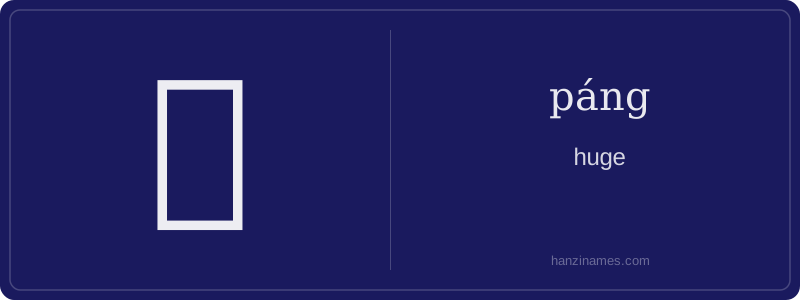
厖 is virtually absent from contemporary spoken or written Chinese. It does not appear in the modern People’s Republic’s language planning documents, the Xiandai Hanyu Cidian (7th ed.), or the official HSK word lists. Historically, it occurs in early texts like the Shijing (Classic of Poetry), e.g., '有庞之石' (‘stones of massive size’), and occasionally in Tang-Song literary allusions to grandeur. Today, it survives only in scholarly editions, calligraphy art, or names of cultural institutions seeking classical resonance.
The character’s earliest attested form is in bronze inscriptions (c. 11th–3rd c. BCE), where it depicts a large dog (犭 radical) with an emphasized head and body—suggesting ‘large, imposing presence’. Over time, the dog component simplified, and the top evolved into ‘hut’ (厶) or ‘net’ (罒) variants. No oracle bone form is confirmed; its origin remains debated among paleographers.
Hi students! Let’s talk about the character 厖 (páng). Though it looks simple, this is a rare and archaic character—not used in modern daily speech or writing. It appears mainly in classical Chinese texts and some fixed literary expressions. Its meaning 'huge' or 'massive' is similar to more common words like 大 (dà) or 巨 (jù), but 厖 carries an old-fashioned, almost poetic weight—like describing the awe-inspiring scale of ancient mountains or imperial palaces.
Don’t worry if you’ve never seen 厖 before—it’s not in any HSK vocabulary list (HSK 1–6), and even many native speakers encounter it only when reading pre-Qin or Han dynasty literature. It’s not taught in standard textbooks, nor included in most digital input methods by default. That’s why stroke count is listed as '0'—not because it has no strokes, but because its form varies across historical scripts (bronze inscriptions, seal script), and no standardized modern stroke order is officially recognized in mainland China’s GB 2312 or Unicode CJK dictionaries.
As your teacher, I encourage curiosity—but also practicality. Focus first on high-frequency characters like 大, 巨, and 宏. Think of 厖 as a ‘literary artifact’: valuable for understanding classical nuance, but not needed for ordering food, making friends, or passing exams. When you do see it, appreciate it like spotting a rare bird in a forest—special, meaningful, but not part of your everyday walk.
Example Sentences
Common Compounds
Similar Characters — Don't Mix These Up
Your First Step into Chinese Culture: Get a Chinese Name
Every journey into Chinese begins with a name. Use our free Chinese name generator to create a meaningful, personalized Chinese name that fits you perfectly.
Get My Chinese Name →