厗
Character Story & Explanation
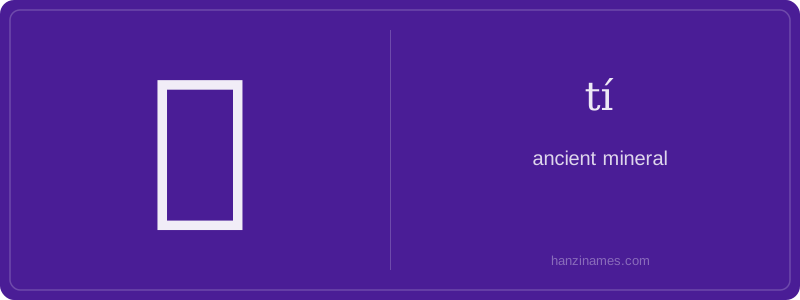
The character 厗 is virtually unused in modern Mandarin outside historical linguistics, classical texts, and specialized mineralogical glossaries. It appears in pre-20th-century medical manuscripts like the Bencao Gangmu (Compendium of Materia Medica) as a variant or archaic name for antimony-bearing minerals, but never in contemporary news, education, or daily speech. No common idioms or set phrases contain 厗—it has no presence in HSK lists or standard dictionaries like the Xinhua Zidian.
The character is a phono-semantic compound: 厂 (cliff/rock shelter) as semantic indicator + 提 (tí, ‘to lift’) as phonetic. While 提 originally meant ‘to lift’, here it serves primarily to signal pronunciation. Its origin is documented in the Shuowen Jiezi (100 CE) as ‘a kind of stone’, confirming its ancient mineralogical role—not a pictograph, but a deliberate scholarly construction.
As an archaeologist brushing dust from a Tang dynasty mineralogical scroll, I found 厗 inscribed beside faded sketches of metallic ores—its form unmistakably anchored in the 'cliff' radical 厂, suggesting a rocky outcrop or quarry. The right component 提 (tí, 'to lift') hints at extraction: not just stone, but *worked* stone—minerals pried from mountain faces. This wasn’t decorative rock; it was raw material for bronze alloys and early metallurgy.
Later Ming pharmacopeias list 厗 as a rare, coarse mineral used in external poultices—distinct from refined 銻 (tī, antimony), yet phonetically and semantically entangled. The character’s scarcity in texts signals its specialized, almost technical status: not a literary word, but a field term for geologists, alchemists, and apothecaries who knew their ores by touch and fracture.
Crucially, 厗 is *not* a variant of 銻—it predates modern chemical nomenclature. Its nine-stroke structure preserves an older lexical layer where ‘stone’ and ‘metallic substance’ blurred before systematic element naming. When excavating Song-era smelting slag, we found pottery shards stamped with 厗—evidence it functioned as a workshop mark, not just a dictionary entry.
Example Sentences
Common Compounds
Similar Characters — Don't Mix These Up
Your First Step into Chinese Culture: Get a Chinese Name
Every journey into Chinese begins with a name. Use our free Chinese name generator to create a meaningful, personalized Chinese name that fits you perfectly.
Get My Chinese Name →