厝
Character Story & Explanation
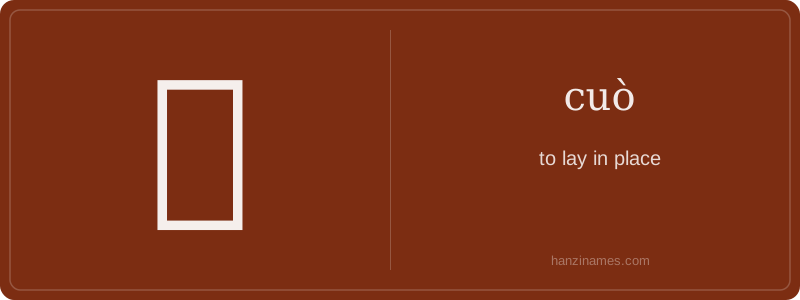
厝 is widely used in southern Fujian and Taiwan, where it functions as a colloquial word for 'house' (e.g., 红厝 hóng cuò = red-tiled traditional house). In formal contexts, it retains its classical meaning 'to lay in place', notably in phrases like 厝火积薪 (cuò huǒ jī xīn) — an idiom from the Han dynasty meaning 'to place fire under stacked firewood', i.e., creating imminent danger. This phrase appears in the *Book of Han* and remains in literary usage today.
The character’s form isn’t a pictograph but a phono-semantic compound: 厂 (radical, indicating shelter/structure) + 昔 (sound component, also contributing semantic weight related to 'past' or 'established time'). There's no oracle-bone script attestation; its earliest verified forms appear in bronze inscriptions and the *Shuōwén Jiězì* (2nd c. CE), confirming its use for deliberate placement.
Hi students! Today we’re learning 厝 (cuò), a character that means 'to lay in place' — like placing something carefully and securely, not just dropping it. It’s often used for positioning objects, bodies (in funerary contexts), or even abstract things like plans or foundations. Though not common in modern Mandarin daily speech, it appears frequently in formal writing, historical texts, and especially in Minnan (Hokkien) dialects spoken in Fujian and Taiwan — where it also means 'house' or 'residence'. Don’t confuse it with similar-sounding characters like 错 (error)!
This character has 10 strokes and belongs to the 厂 (hǎn) radical — which originally depicted a cliff or overhanging rock, and often relates to shelter, structure, or spatial placement. Its structure combines 厂 (shelter) with 昔 (xī, 'past'), suggesting 'a place laid down long ago' — hinting at permanence or established positioning. The pronunciation cuò is third tone: firm and falling-rising.
As a beginner, focus first on recognizing its shape and meaning rather than memorizing all uses right away. Practice writing it slowly, following stroke order: start with the horizontal stroke of 厂, then complete the inner 昔 part. While it’s not in the HSK list (so no official HSK level), it’s valuable for learners interested in classical Chinese, regional dialects, or reading tomb inscriptions and old architecture records. Think of it as a 'cultural key' character — small but meaningful!
Example Sentences
Common Compounds
Similar Characters — Don't Mix These Up
Your First Step into Chinese Culture: Get a Chinese Name
Every journey into Chinese begins with a name. Use our free Chinese name generator to create a meaningful, personalized Chinese name that fits you perfectly.
Get My Chinese Name →