厞
Character Story & Explanation
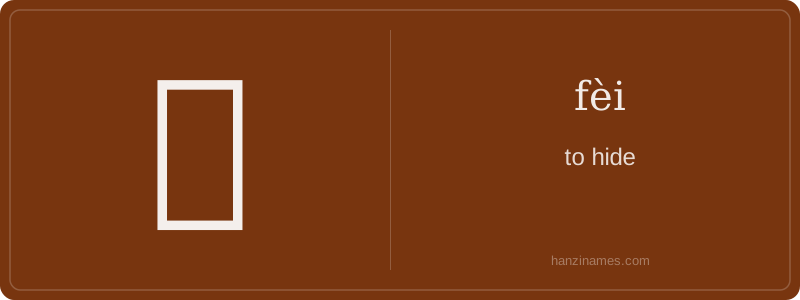
厞 appears almost exclusively in classical Chinese texts and formal literary registers—not in daily speech, news, or HSK materials. It survives in historical compounds like 厞室 (fèi shì), meaning 'a concealed chamber' or 'side room' in ancient architecture, notably referenced in the Rites of Zhou (Zhou Li) and Tang dynasty poetry to denote ritually secluded spaces. Modern usage is limited to scholarly editions, classical poetry anthologies, or stylistic allusions in essays.
The character’s form combines 广 (guǎng, 'roof' radical, indicating a sheltered space) with 匹 (pǐ, originally a pictograph of cloth folded, later phonetic). Its structure reflects its meaning: a covered, bounded area—literally 'under the roof, out of sight'. No oracle-bone or bronze script forms are attested; it first appears in seal script during the Warring States period as a specialized architectural/ritual term.
The character 厞 (fèi) is a rare, literary word meaning 'to hide' or 'to conceal', deeply rooted in classical Chinese texts. Unlike common synonyms like 藏 (cáng) or 隐 (yǐn), 厞 carries an archaic, almost poetic weight—suggesting concealment not just of objects, but of intention, presence, or truth. Its scarcity in modern speech reflects a broader cultural value: what is hidden is often deemed sacred, strategic, or socially delicate—think of the Confucian ideal of modesty (谦逊) or the Daoist reverence for the unseen (无为之隐).
In traditional Chinese cosmology, concealment isn’t passive erasure but active preservation—like storing grain before winter or shielding a scholar’s draft manuscript from premature judgment. 厞 evokes this mindful withdrawal: hiding to protect, to mature, or to await the right moment. It mirrors the yin principle—receptive, inward, and essential to balance. This isn’t secrecy for deception, but silence as wisdom.
Its rarity today makes 厞 a linguistic relic that opens a window into pre-modern sensibilities: where language itself was curated, and every act of concealment carried moral gravity. To use 厞 was to invoke ritual precision—not hiding *anything*, but hiding *with purpose*. In contemporary China, encountering it signals literacy in classical thought, often in academic, literary, or calligraphic contexts. Thus, 厞 embodies a worldview where meaning resides as much in what is withheld as in what is revealed.
Example Sentences
Common Compounds
Similar Characters — Don't Mix These Up
Your First Step into Chinese Culture: Get a Chinese Name
Every journey into Chinese begins with a name. Use our free Chinese name generator to create a meaningful, personalized Chinese name that fits you perfectly.
Get My Chinese Name →