厥
Character Story & Explanation
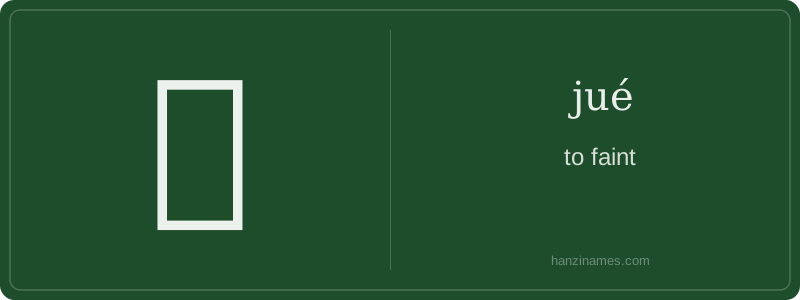
厥 is primarily used today in formal, literary, or medical contexts—not in casual speech. It appears in classical texts like the Huangdi Neijing (Yellow Emperor’s Inner Canon), where 气厥 (qì jué) and 血厥 (xuè jué) describe types of syncope rooted in traditional Chinese medicine theory. Modern usage is limited to academic papers, TCM textbooks, and idioms like 厥功至伟 (jué gōng zhì wěi)—though here 厥 functions archaically as 'remarkable', showing semantic evolution. It's also found in historical records describing emperors or scholars fainting during intense emotion or ritual.
The character’s earliest attested form appears in Warring States bamboo slips and Han dynasty seals. Its structure combines the '厂' radical (originally depicting a cliff or overhanging rock) with '欮', a phonetic component. While no pictographic origin survives, its composition reflects ancient script conventions: radical + phonetic, not visual metaphor. In real life, Chinese learners encounter it most often while reading classical quotations or studying acupuncture theory.
Hi students! Today we’re learning 厥 (jué), a classical Chinese character meaning 'to faint' or 'to lose consciousness'. Though rarely used in modern spoken Mandarin, it appears frequently in formal writing, medical texts, and classical literature. Its pronunciation is straightforward—just one syllable, jué—but be careful not to confuse it with similar-sounding words like juē (to dig) or juè (to feel cold). This character belongs to the '厂' (hǎn) radical, which often relates to cliffs or shelters—but here, it’s mainly a phonetic-semantic component, not a literal pictograph.
厥 is an example of a 'literary monosyllabic verb'—a type of word preserved from ancient Chinese that survives mainly in fixed expressions and idioms. You’ll almost never hear it in daily conversation ('I fainted' is usually 我晕倒了 wǒ yūndǎo le), but you *will* see it in phrases like 气厥 (qì jué, 'fainting due to qi disruption') in Traditional Chinese Medicine contexts. Its twelve-stroke structure follows a logical sequence: start with the '厂' roof, then add strokes downward and rightward—practice slowly with tracing sheets!
As a beginner, don’t worry about mastering 厥 for speaking—it’s low-frequency in HSK exams (not included in HSK 1–6). Instead, treat it as a 'reading key': recognizing it helps unlock classical passages, historical documents, and medical terminology. Think of it like learning 'thou' in English—it won’t help you order coffee, but it *will* let you read Shakespeare or Confucian texts. Focus on its shape, sound, and core meaning: sudden loss of consciousness. That’s your anchor!
Example Sentences
Common Compounds
Similar Characters — Don't Mix These Up
Your First Step into Chinese Culture: Get a Chinese Name
Every journey into Chinese begins with a name. Use our free Chinese name generator to create a meaningful, personalized Chinese name that fits you perfectly.
Get My Chinese Name →