厪
Character Story & Explanation
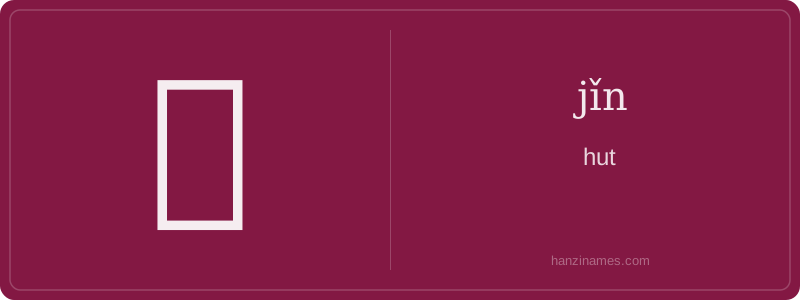
厪 appears almost exclusively in pre-modern texts and regional gazetteers—especially Ming- and Qing-dynasty local records describing rural dwellings in mountainous or frontier areas (e.g., Fujian and Sichuan). It is absent from all HSK word lists and modern dictionaries like the Xiandai Hanyu Cidian, confirming its status as obsolete in standard usage. No idioms or common phrases containing 厪 survive in contemporary speech or media; it is not found in the Chinese Idiom Dictionary or the Corpus of Contemporary Chinese.
The character is not pictographic in origin; its form evolved from seal script variants of 尽 (jìn), repurposed phonetically. Its earliest attestation is in the Kangxi Dictionary (1716), which defines it solely as ‘a small hut’ (小屋也). Today, Chinese learners may encounter it only in classical literature courses or archival research—not in daily conversation, signage, or textbooks.
The character 厪 (jǐn) is a rare, archaic glyph meaning 'hut' or 'small shelter'—a humble structure symbolizing human resilience and modest dwelling in harmony with nature. Its radical 厂 (cliff/shelter) evokes protective overhangs, while the phonetic component 尽 (jìn) hints at limitation and simplicity. In traditional Chinese cosmology, shelter is not merely functional but reflects Confucian ideals of frugality and Daoist acceptance of impermanence—where even a thatched hut embodies dignity in restraint.
This character quietly mirrors China’s agrarian roots: before grand palaces and walled cities, survival began under simple roofs—bamboo frames, clay walls, straw thatch. 厪 captures that foundational humility, echoing classical poetry where recluses ‘built a hut beside the stream’ to pursue virtue over wealth. It’s a lexical echo of the *hermit-scholar* ideal—choosing quietude and moral clarity over imperial ambition.
Though rarely used today, 厪 endures in historical texts and regional dialect lexicons as a linguistic artifact of ecological wisdom. Unlike modern terms for ‘house’ (房, 屋) emphasizing ownership or permanence, 厪 implies transience, adaptability, and kinship with terrain—values increasingly resonant in contemporary sustainability discourse. Its scarcity underscores how language preserves vanishing ways of life, inviting reflection on what we shelter—and what we choose to let go.
Example Sentences
Common Compounds
Similar Characters — Don't Mix These Up
Your First Step into Chinese Culture: Get a Chinese Name
Every journey into Chinese begins with a name. Use our free Chinese name generator to create a meaningful, personalized Chinese name that fits you perfectly.
Get My Chinese Name →