叟
Character Story & Explanation
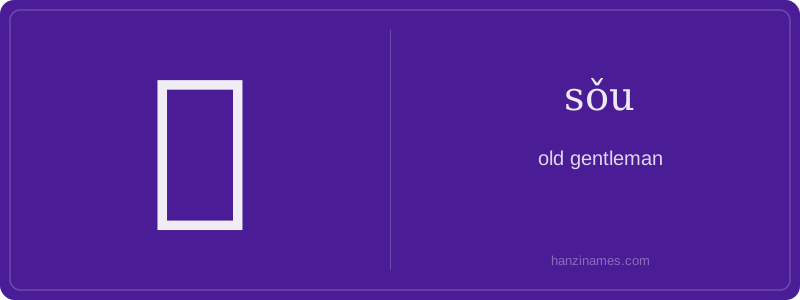
In modern Chinese, 叟 appears almost exclusively in literary, historical, or idiomatic contexts—not in daily speech. It features in the classical idiom ‘童叟无欺’ (tóng sǒu wú qī), meaning ‘no deception of children or elders’, still used on shop signs to signify honesty. Historically, it appeared in pre-Qin and Han texts to respectfully refer to aged male figures—e.g., Mencius addresses a village elder as ‘东郭叟’ (Dōngguō sǒu, ‘the elder from Dongguo’). It is absent from HSK 1–6 official lists, indicating its status as a low-frequency, high-register character.
The character’s form is not pictographic but phono-semantic: the left 又 is a common radical used for phonetic or grammatical function, while the right 尢 (yóu, archaic variant of 尤) originally depicted a person with a pronounced physical trait—often interpreted as a hunched, elderly figure. This visual echo of aged posture is documented in Shuowen Jiezi (100 CE), China’s first dictionary, confirming its early association with venerable age.
As an archaeologist brushing dust from a Han dynasty bamboo slip, I find 叟 not carved in oracle bone but inscribed with quiet authority in clerical script—its nine strokes revealing a layered social fossil. The radical 又 (‘again’, ‘also’) anchors it not as repetition, but as a functional marker: historically, 又 often signals phonetic or grammatical function rather than meaning, hinting this character’s core lies elsewhere—perhaps in its phonetic component, 尢 (yóu), an ancient glyph denoting a limping elder, subtly preserved in 叟’s upper right.
This character doesn’t shout age—it whispers gravitas. Unlike 老 (lǎo) or 年长者 (niánzhǎng zhě), 叟 carries literary austerity: a term used in classical texts like the *Mencius* to address venerable men without familial relation—like a sage met on a mountain path. Its tone (sǒu, third tone) falls like a measured bow: neither deferential nor familiar, but respectfully distant, embodying Confucian ideals of hierarchical respect embedded in lexical form.
Excavating further, I note how 叟 rarely stands alone in modern usage—yet survives tenaciously in compound nouns and idioms, like a relic repurposed in ritual architecture. It resists colloquial erosion because it fulfills a precise semantic niche: not just ‘old man’, but ‘an old man whose age confers moral weight’. Its survival isn’t accidental; it’s curated—preserved in dictionaries, recited in classical poetry, and taught in advanced HSK curricula as a marker of textual literacy, not conversational fluency.
Example Sentences
Common Compounds
Similar Characters — Don't Mix These Up
Your First Step into Chinese Culture: Get a Chinese Name
Every journey into Chinese begins with a name. Use our free Chinese name generator to create a meaningful, personalized Chinese name that fits you perfectly.
Get My Chinese Name →