叩
Character Story & Explanation
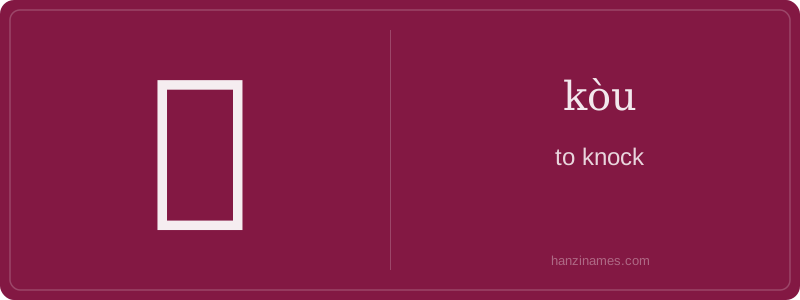
In daily life, 叩 appears most commonly in formal or literary contexts—not casual door-knocking (which uses 敲 qiāo). It features in classical idioms like 叩石垦壤 (kòu shí kěn rǎng), from the Daoist parable 'The Foolish Old Man Who Moved Mountains', meaning 'to chip at stone and till soil'—symbolizing humble, persistent effort. Historically, 叩 was used in imperial rituals: officials would 'kòu tóu' (kowtow) by knocking their heads to the ground as supreme obeisance before the emperor or ancestors.
The character’s earliest attested form appears in bronze inscriptions of the Western Zhou (c. 1046–771 BCE), where it depicts a hand striking a mouth-shaped enclosure—likely representing the act of striking a door or gate with clear intent. Unlike pictographic characters like 日 (sun), 叩 evolved from a composite ideograph emphasizing action + boundary, not visual resemblance.
At first glance, 叩 (kòu) appears simple—a five-stroke character meaning 'to knock'—but it opens a door into the Chinese worldview where sound, respect, and intention are inseparable. In traditional culture, knocking is never mere physical contact; it is a sonic ritual marking boundaries between private and public, human and sacred space. The act signals awareness, restraint, and deference—before entering a room, approaching a teacher, or even addressing heaven in prayer.
This character embodies the Confucian ideal of *li* (ritual propriety): form matters because it shapes moral disposition. A gentle, rhythmic knock reflects inner humility; a harsh, repeated one suggests arrogance or urgency that breaches decorum. Even today, elders remind children to ‘knock three times softly’—not just for permission, but as embodied ethics. Sound becomes virtue made audible.
The radical 口 (mouth) is key: though 叩 is not about speech, it locates the action in the realm of intentional human expression—like calling out, reciting, or chanting. Knocking resonates as a vocalized gesture: not silent, but measured, audible, relational. Thus 叩 reveals a deeper truth—that in Chinese thought, even non-verbal acts carry linguistic weight, participating in the same ethical grammar as words. To knock is to speak with your knuckles.
Example Sentences
Common Compounds
Similar Characters — Don't Mix These Up
Your First Step into Chinese Culture: Get a Chinese Name
Every journey into Chinese begins with a name. Use our free Chinese name generator to create a meaningful, personalized Chinese name that fits you perfectly.
Get My Chinese Name →