叱
Character Story & Explanation
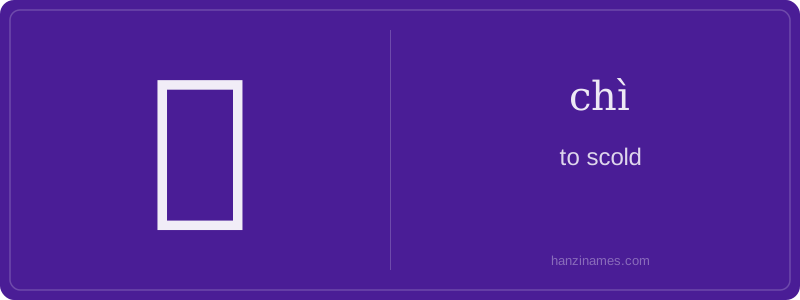
叱 is commonly found in classical texts and modern literary or journalistic critique. It appears in the idiom 叱咤风云 (chìzhà fēngyún), meaning 'to command great influence'—originally describing heroic generals whose shouts could stir wind and clouds (recorded in the 5th-century *Shishuo Xinyu*). In contemporary usage, it appears in formal writing: media headlines may say ‘专家叱责造假行为’ (experts sharply rebuke fraud), signaling moral authority rather than emotional outburst.
The character first appeared in seal script (c. 3rd century BCE), with 口 (mouth) + 七 (seven) as phonetic component—no pictographic origin. The ‘seven’ is purely sound-based (qī → chì via historical sound shift), not numeric symbolism. Today, Chinese learners encounter it most often in HSK-level reading passages on ethics or leadership, not daily conversation.
The character 叱 (chì) embodies a culturally precise form of verbal reprimand—sharp, immediate, and authoritative. Unlike generic ‘scolding’, 叱 implies a sudden, forceful utterance, often from a position of moral or hierarchical authority. Its oral radical 口 underscores that this is not silent disapproval but vocalized censure, rooted in Confucian ideals where speech carries ethical weight: words must be measured, yet when justice demands, they must cut clearly.
In traditional Chinese pedagogy and governance, 叱 was never mere anger—it signaled boundary enforcement with purpose. A teacher 叱-ing a student corrected not just behavior but moral orientation; an official 叱-ing corruption affirmed communal integrity. This reflects the Daoist-Confucian balance: restraint in daily speech, but unflinching clarity when principle is at stake—making 叱 a linguistic embodiment of righteous urgency.
Modern usage retains this gravitas: 叱 appears more in literature, formal criticism, or historical discourse than casual chat. It’s rarely used lightly—its five-stroke simplicity belies its semantic weight. To choose 叱 over synonyms like 骂 (to curse) or 责 (to blame) is to invoke dignity in correction, aligning language with virtue. Thus, 叱 offers a window into how Chinese culture treats speech—not as noise, but as moral action calibrated by context, intent, and responsibility.
Example Sentences
Common Compounds
Similar Characters — Don't Mix These Up
Your First Step into Chinese Culture: Get a Chinese Name
Every journey into Chinese begins with a name. Use our free Chinese name generator to create a meaningful, personalized Chinese name that fits you perfectly.
Get My Chinese Name →