吔
Character Story & Explanation
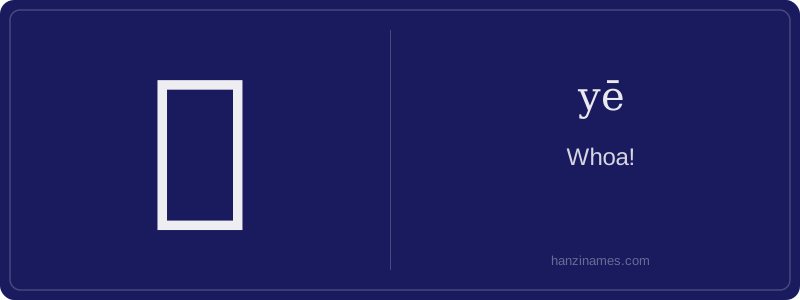
吔 (yē) is a modern internet-born interjection with no documented historical usage before the 2010s. It appears frequently in Chinese social media (Weibo, Xiaohongshu, Douyin comments) and livestream chats to express mild shock, irony, or playful disbelief—e.g., reacting to a celebrity’s unexpected hairstyle or a friend’s absurd excuse. No standard idiom or compound includes it; it stands alone as a vocalization.
Its written form has no pictographic or semantic origin—it’s a phonetic stand-in using the character 吔 (which historically meant 'to suck' or 'to sip' in rare classical texts, but that sense is obsolete). Today, Chinese speakers type 吔 because it approximates the sound /yē/ and visually signals informality. The character is not taught in schools and carries zero HSK relevance—but it’s instantly recognizable to millions as the ‘gasp-of-irony’ glyph.
吔 (yē) is not a standard Chinese character in formal writing or dictionaries—it’s a phonetic, colloquial interjection used almost exclusively in spoken Mandarin and informal digital communication. It captures a sharp, breathy gasp of sudden surprise or disbelief—like an audible ‘Yeh?!’ with raised eyebrows. Think of it as the textual equivalent of a cartoon character’s ‘YIKES!’ but softer, more bemused than panicked.
This character has no classical roots: it doesn’t appear in the Kangxi Dictionary, nor in any major historical corpus. Its existence is purely modern, born from internet slang and vocal mimicry. Linguists classify it as a ‘phonographic loan’—a character borrowed solely for its sound (yē), not meaning or etymology. It’s often typed in chats or social media to punctuate reactions when something absurd, ironic, or unexpectedly delightful happens.
While 吔 is widely recognized among young netizens across China, it’s deliberately excluded from standardized tests like HSK and official character lists (e.g., GB2312, Unicode’s CJK Unified Ideographs). Its usage thrives in contexts where tone and spontaneity matter more than orthography—think WeChat group banter, Bilibili comment sections, or live-streaming overlays. It reflects how digital culture reshapes language: not through stroke count or radicals, but through shared sonic instinct.
Example Sentences
Common Compounds
Similar Characters — Don't Mix These Up
Your First Step into Chinese Culture: Get a Chinese Name
Every journey into Chinese begins with a name. Use our free Chinese name generator to create a meaningful, personalized Chinese name that fits you perfectly.
Get My Chinese Name →