吠
Character Story & Explanation
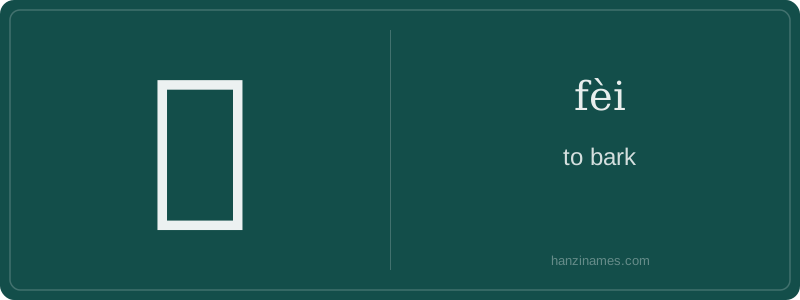
吠 is rarely used alone in modern Mandarin; it appears primarily in fixed expressions and literary or rhetorical contexts. It features in the idiom 狗急跳墙,狂犬吠日 (gǒu jí tiào qiáng, kuáng quǎn fèi rì) — 'a desperate dog leaps over a wall; a rabid dog barks at the sun' — metaphorically describing futile, irrational opposition. Historically, it appears in Tang dynasty poetry and Ming-Qing vernacular fiction to evoke chaos, alarm, or absurd defiance.
The character is not pictographic (no ancient dog image); its earliest attestation is in seal script (c. 3rd century BCE), where it clearly combines 口 (mouth/sound) and 弗 (fú, a phonetic component meaning 'not', here used solely for sound). Its form has remained stable for over 2,200 years — a testament to how precisely Chinese writing encodes vocal action independent of visual representation.
At first glance, 吠 (fèi) appears simple—a dog’s bark rendered in ink. Yet this character embodies a profound Chinese linguistic principle: sound symbolism through the mouth radical 口. Unlike English onomatopoeia that mimics noise externally, 吠 locates barking *within the human act of articulation*, reflecting a worldview where vocal expression is intrinsically tied to intention, agency, and social signaling—not just animal instinct.
In classical Chinese thought, voice (声, shēng) bridges inner qi and outer reality. A dog’s bark, though non-human, is still ‘voiced’—thus 吠 subtly places canine behavior within the moral-linguistic order: barking may warn, threaten, or betray anxiety, much like human speech. This mirrors Confucian attention to *how* something is expressed—not merely *what* is said—and why even animal sounds warrant a dedicated character with ethical resonance.
The choice of 口 (mouth) as its sole radical—no dog-related component like 犭 (dog radical)—is telling. It emphasizes *audibility* and *utterance*, not zoology. In traditional Chinese phonetics, fèi approximates the sharp, explosive quality of barking; the character thus functions as both acoustic notation and semantic anchor. This reveals a culture that treats sound as culturally legible, socially consequential, and worthy of precise graphical representation—even across species boundaries.
Example Sentences
Common Compounds
Similar Characters — Don't Mix These Up
Your First Step into Chinese Culture: Get a Chinese Name
Every journey into Chinese begins with a name. Use our free Chinese name generator to create a meaningful, personalized Chinese name that fits you perfectly.
Get My Chinese Name →