吥
Character Story & Explanation
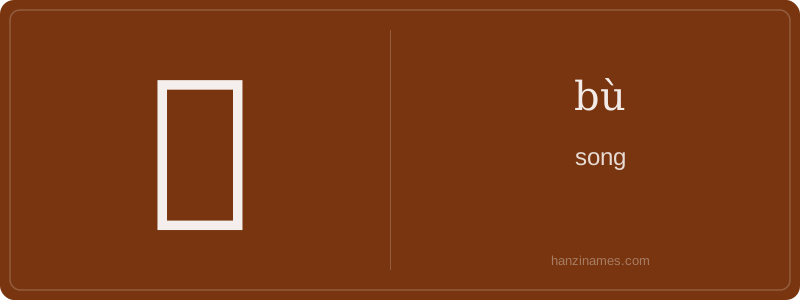
吥 appears almost exclusively in the now-archaic transliteration 嗊吥 (sòng bù), historically used in early 20th-century Shanghai and Guangzhou entertainment contexts—such as sheet music covers, theater posters, or phonograph labels—to approximate the English word 'song'. It was never part of formal education, dictionaries, or daily writing. No idioms, proverbs, or literary works feature 吥 independently. Its usage faded after the 1950s with the standardization of pinyin and adoption of more systematic transliteration conventions (e.g., 'song' → 桑).
The character 吥 has no documented ancient origin—it is not found in oracle bone, bronze, or seal scripts. It is a modern, ad hoc graphical variant of 不, likely created by printers or typesetters to visually distinguish the borrowed syllable from the negation particle. Today, it survives only in archival materials, antique advertisements, and linguistic studies of Sino-foreign phonetic borrowing.
The Chinese character 吥 (bù) is not a standard, independently meaningful character in modern Mandarin. It is a rare, non-HSK, phonetic transcription glyph—primarily used in the fixed compound 嗊吥 (sòng bù), a transliteration of the English word 'song' as pronounced in certain regional or historical Chinese dialectal renderings (e.g., Cantonese-influenced or early 20th-century phonetic loan usage). It carries no semantic weight on its own and appears exclusively in this borrowed context.
Unlike core functional characters like 不 (bù, 'not'), 吥 has no dictionary entry in authoritative sources such as the *Xiàndài Hànyǔ Cídiǎn* (Contemporary Chinese Dictionary) or the *Guóyǔ Cídiǎn*. Its form resembles a stylized or variant rendering of 不—but without standardized stroke count, radical classification, or pedagogical recognition. It is absent from all HSK levels and Unicode’s CJK Unified Ideographs block in mainstream use (though encoded in extension areas for legacy compatibility).
This character exemplifies how Chinese orthography occasionally accommodates foreign phonemes through ad hoc character selection—similar to how Japanese katakana uses ッ for glottal stops or German ‘sch’ is rendered as スヒ in older transcriptions. Its existence underscores the pragmatic flexibility of Chinese writing when confronting unassimilable sounds, rather than linguistic necessity or semantic depth.
Example Sentences
Common Compounds
Similar Characters — Don't Mix These Up
Your First Step into Chinese Culture: Get a Chinese Name
Every journey into Chinese begins with a name. Use our free Chinese name generator to create a meaningful, personalized Chinese name that fits you perfectly.
Get My Chinese Name →