吰
Character Story & Explanation
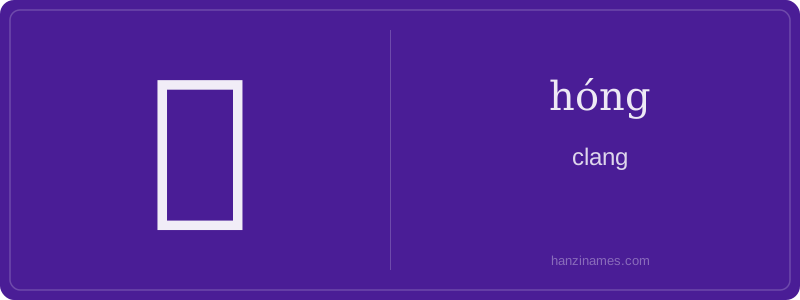
吰 is exceptionally rare in contemporary usage and does not appear in any HSK vocabulary list, modern textbooks, or common idioms. It is absent from the People’s Republic’s standardized character lists (e.g., GB2312, GB18030) and is not included in the 8,105 characters of the 2022 Revised List of Commonly Used Characters. Its documented appearances are limited to pre-modern rhymed prose (fu) and Tang–Song dynasty poetry, where it intensifies descriptions of ritual bronze bells (zhōng) or temple gongs. For example, the Tang poet Li He used 吰 in a line describing the echoing resonance of ceremonial music.
The character’s structure combines 口 (kǒu, 'mouth/sound') and 厷 (gōng, an archaic variant of 'arm', here functioning phonetically). While its earliest attestation is in the Kangxi Dictionary (1716), no oracle-bone or bronze-inscription forms are verified. In practice today, Chinese speakers substitute 轟, 鐘 (zhōng), or onomatopoeic phrases like ‘当当’ (dāng dāng) — not 吰 — to describe clang-like sounds.
Hello students! Today we’ll explore the character 吰 (hóng), which means 'clang' — that sharp, resonant metallic sound, like a temple bell or gong struck powerfully. It’s a phonetic-ideographic character (xíngshēng), where the left side (口 kǒu, 'mouth') suggests it relates to sound or utterance, and the right side (厷 gōng, an ancient form of 'arm' or 'elbow') primarily serves as a phonetic clue for pronunciation. Though rare in daily speech, 吰 appears in classical and literary contexts to evoke vivid auditory imagery.
This character is not part of modern spoken Mandarin colloquial vocabulary — you won’t hear it in casual conversation or beginner dialogues. Instead, it lives in poetic or descriptive writing, especially when evoking solemn, reverberating sounds: temple bells, bronze chimes, or even metaphorical 'resonance' of words or deeds. Its rarity makes it a beautiful example of how Chinese preserves rich sonic nuance through specialized characters.
Don’t confuse 吰 with the far more common character 洪 (hóng, 'flood; vast'), which shares the same pronunciation but differs radically in meaning and usage. 吰 is also distinct from 轟 (hōng, 'boom; rumble'), which describes louder, sustained explosive sounds. As learners, recognizing these subtle distinctions helps deepen your sensitivity to Chinese onomatopoeia and literary texture — even if you won’t use 吰 every day, understanding it enriches your reading of classical poetry and historical texts.
Example Sentences
Common Compounds
Similar Characters — Don't Mix These Up
Your First Step into Chinese Culture: Get a Chinese Name
Every journey into Chinese begins with a name. Use our free Chinese name generator to create a meaningful, personalized Chinese name that fits you perfectly.
Get My Chinese Name →