吱
Character Story & Explanation
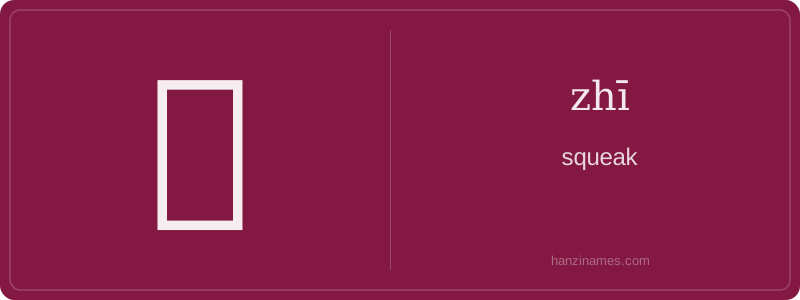
吱 is widely used in modern Mandarin speech and informal writing to depict high-frequency, intermittent mechanical or animal sounds. It appears in common reduplicated forms like 吱吱 (zhīzhī), frequently in children’s books (e.g., describing mice or toys) and everyday descriptions — such as ‘门吱吱地响’ (the door creaked softly). While not in core HSK lists (HSK Level: Not assigned — outside top 3,000 most frequent characters), it’s recognized in the Xiàndài Hànyǔ Cídiǎn (Contemporary Chinese Dictionary) and taught in elementary language curricula for onomatopoeia units.
The character is a phono-semantic compound: 口 (mouth radical) indicates sound-related meaning, while 支 (zhī, ‘to support’ or ‘branch’) provides the primary phonetic cue. Though 支 originally meant ‘branch’ or ‘support’, its ancient pronunciation aligned closely with 吱, making it a reliable sound scaffold. No oracle-bone or bronze inscriptions of 吱 exist — it first appeared in late imperial texts and became standardized in the 20th century as part of modern onomatopoeic orthography.
吱 (zhī) is an onomatopoeic Chinese character that vividly captures the sharp, high-pitched sound of something creaking or squeaking — like an old door hinge, a rusty gate, or a wooden floorboard under pressure. Its mouth radical (口) signals its connection to vocalized or audible phenomena, even though it represents a non-verbal sound. Unlike English ‘creak’ or ‘squeak’, which are verbs or nouns, 吱 functions primarily as an interjection or adverb in Chinese, often reduplicated (吱吱) for emphasis and rhythmic authenticity.
This character reflects a broader linguistic tendency in Chinese to encode sensory experience directly into writing: sounds aren’t just described — they’re *performed* orthographically. The dual pronunciation zhī (standard) and zī (colloquial variant, especially in northern dialects and reduplicated forms like 吱吱) adds phonetic flexibility, mirroring how real-world sounds vary by context and speaker. It’s rarely used in formal writing but thrives in spoken narratives, children’s literature, and descriptive prose.
In Western cultures, equivalent sounds are often rendered with words like ‘squeak’, ‘creak’, or ‘screech’ — but these carry stronger connotations of discomfort or alarm. By contrast, 吱 can be neutral or even endearing: a mouse’s tiny 吱吱 is playful; a swinging bamboo chair’s gentle 吱 is nostalgic. This subtle emotional range reveals how Chinese onomatopoeia embeds tone and attitude directly into sound-words — not through adjectives, but through phonetic texture and repetition.
Example Sentences
Common Compounds
Similar Characters — Don't Mix These Up
Your First Step into Chinese Culture: Get a Chinese Name
Every journey into Chinese begins with a name. Use our free Chinese name generator to create a meaningful, personalized Chinese name that fits you perfectly.
Get My Chinese Name →