吽
Character Story & Explanation
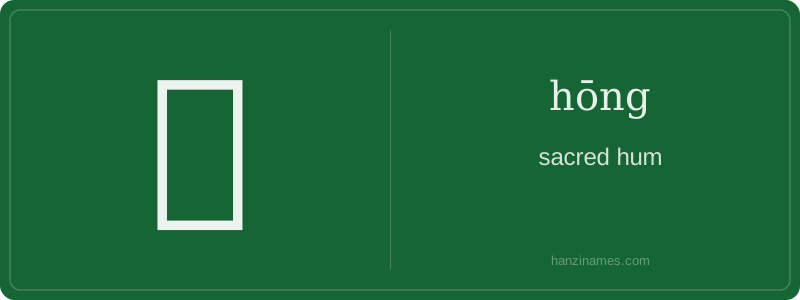
吽 is rarely used in secular modern Chinese daily life. Its primary documented usage is in Buddhist liturgy, especially in mantras like the Six-Syllable Mantra of Avalokiteśvara (唵嘛呢叭咪吽, ōng mā nī bā mī hōng), widely recited across Han and Tibetan Buddhist communities in China. It appears in temple inscriptions, sutra manuscripts (e.g., Dunhuang manuscripts), and ritual manuals since at least the Tang dynasty (618–907 CE). While not found in classical poetry or vernacular fiction, it endures in chanting practice and religious art.
The character is a phono-semantic compound: 口 (mouth radical, indicating speech/sound) + 牛 (niú, ‘ox/cow’, here serving phonetically for hōng/hǒu, though its semantic link to deep resonant sound is culturally reinforced). It does not originate from oracle bone or bronze inscriptions—it first appears in medieval Buddhist transliteration texts, adapted to render Sanskrit ‘hūṃ’ (हूँ) with Chinese phonetic and symbolic resources.
At first glance, 吽 appears as a simple phonetic symbol—but it opens a profound portal into Chinese Buddhist cosmology. Unlike ordinary onomatopoeia, 吽 embodies the resonant power of sacred sound: not just noise, but vibration that aligns mind, breath, and cosmic energy. In esoteric traditions like Tangmi (Chinese Vajrayāna), it represents the ‘seed syllable’ (bīja) of Avalokiteśvara or Mahākāla—marking the moment when wisdom shatters illusion. Its force lies not in volume, but in intentionality: a sonic anchor for meditation and ritual.
This character reflects the Daoist-Buddhist convergence in Chinese thought: sound as qi in motion. The mouth radical (口) signifies embodied utterance, while the ‘cow’ component (牛) evokes grounded strength and primordial resonance—echoing ancient beliefs that low-frequency sounds (like cattle’s bellow) stir earth energies. Thus, 吽 is never merely vocalized; it is *enacted*—a bodily practice linking speech, breath, and spiritual discipline.
In the Chinese worldview, language transcends representation—it participates in reality. 吽 exemplifies this: its pronunciation (hōng/hǒu) isn’t descriptive but performative. When chanted in temples from Mount Wutai to Guangdong monasteries, it functions like a tuning fork for consciousness—aligning practitioners with dharmic truth. This mirrors Confucian reverence for ‘correct naming’ (zhèngmíng) and Daoist ‘true words’ (zhēnyán): right sound *is* right action. So 吽 is less a word than a ritual technology—a sonic bridge between human voice and universal law.
Example Sentences
Common Compounds
Similar Characters — Don't Mix These Up
Your First Step into Chinese Culture: Get a Chinese Name
Every journey into Chinese begins with a name. Use our free Chinese name generator to create a meaningful, personalized Chinese name that fits you perfectly.
Get My Chinese Name →