吾
Character Story & Explanation
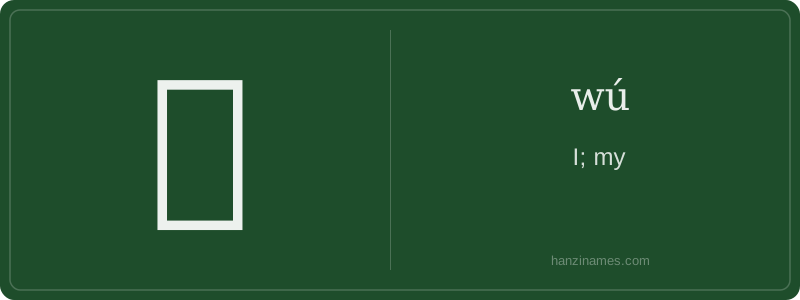
In classical Chinese literature and formal writing, 吾 functions as a literary first-person pronoun meaning 'I' or 'my', still used today in idioms, academic discourse, and set phrases—never in casual speech. It appears in well-documented expressions like 吾日三省吾身 ('I examine myself thrice daily', from the *Analects*) and the idiom 吾行吾素 ('I follow my own course'). Modern usage is restricted to written registers: historical novels, calligraphy, legal documents quoting classics, or rhetorical flourishes in speeches.
The character's form is not pictographic but phonosemantic: 口 (kǒu, 'mouth') signals its connection to speech, while 五 (wǔ, 'five') serves as a phonetic component reflecting Old Chinese pronunciation. No oracle bone form survives; the earliest attested shape appears on Warring States bamboo slips, confirming its role as a refined, non-colloquial pronoun.
As an archaeologist brushing dust from a bamboo slip unearthed in the Guodian Chu tombs (c. 300 BCE), I find 吾 inscribed with quiet authority—not as a boast, but as a grammatical anchor. This character emerges in Warring States texts as a first-person pronoun distinct from 我 (wǒ), carrying literary weight and Confucian humility. Its early usage reflects a speaker positioning themselves within ritual hierarchy, not asserting ego but acknowledging role: 'I, the disciple' or 'I, the minister.'
Under magnification, 吾 reveals its structural logic: 口 (mouth, radical) fused with 五 (wǔ, five)—not numerically, but phonetically. The 'five' component served as a *shengfu* (sound marker), approximating the ancient pronunciation *ŋaʔ*. This phonosemantic design—common in Zhou dynasty bronze inscriptions—shows how scribes prioritized audibility alongside meaning, embedding speech into script long before standardized dictionaries.
Unlike modern 我, 吾 rarely stands alone in classical prose; it anchors reflexive or possessive constructions: 吾身 (my body), 吾道 (my path). It appears over 200 times in the *Analects*, always in dialogues modeling ethical self-awareness. To read 吾 is to hear the measured cadence of pre-Qin pedagogy—where 'I' is never isolated, but always relational, responsible, and ritually grounded.
Example Sentences
Common Compounds
Similar Characters — Don't Mix These Up
Your First Step into Chinese Culture: Get a Chinese Name
Every journey into Chinese begins with a name. Use our free Chinese name generator to create a meaningful, personalized Chinese name that fits you perfectly.
Get My Chinese Name →