舞
Character Story & Explanation
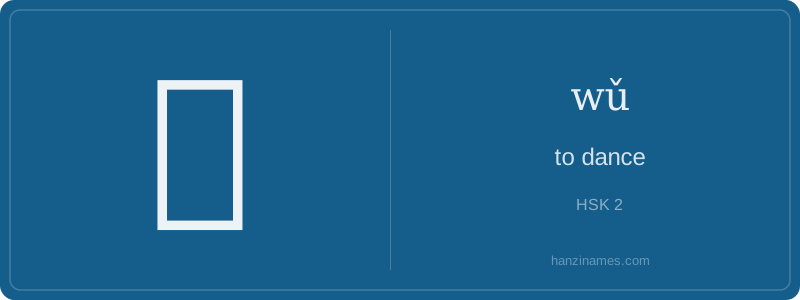
舞 is widely used in modern Chinese across contexts—from ballet schools in Shanghai to square-dance groups in Beijing parks. It appears in standardized phrases like 跳舞 (tiào wǔ, 'to dance'), 舞蹈 (wǔdǎo, 'dance' as an art form), and idioms such as 手舞足蹈 (shǒu wǔ zú dǎo, 'to jump for joy'). Historically, it was central to Confucian state rites: the *Book of Rites* documents six ceremonial dances performed by officials to honor heaven, earth, and ancestors—each with precise steps and symbolic props.
The earliest attested form of 舞 appears in Western Zhou bronze inscriptions (c. 1000 BCE), where it depicts a person with outstretched arms and crossed feet—confirming the 舛 radical’s ancient role in representing ritual stepping. No oracle bone form survives, but bronze script evidence is robust and widely accepted by scholars like Li Xueqin and Wang Hui.
Unearthing this character feels like brushing dust from a bronze ritual vessel—what emerges is not just ‘dance,’ but embodied cosmology. In early inscriptions, 舞 appears in contexts of shamanic rites and ancestral veneration, where movement was neither entertainment nor art alone, but sacred communication with spirits. Its form preserves the rhythm of ritual: two feet (舛) anchoring motion, arms raised (the upper components resembling outstretched sleeves or fluttering banners), and a central element evoking both music and intention.
The radical 舛 (chuǎn), meaning ‘opposed feet’ or ‘crossed steps,’ is key—it signals deliberate, patterned locomotion, not random motion. This distinguishes 舞 from generic verbs for ‘move’ (如 move, 行 walk). Ancient dancers wore long-sleeved robes; the top part of 舞 (the inverted ‘U’ shape + ‘一’ and ‘丿’) likely stylizes those flowing sleeves mid-gesture—a detail confirmed by Han dynasty tomb murals and bronze figurines found at Mawangdui.
Over centuries, 舞 evolved from a solemn rite into broader cultural expression—but never lost its core duality: discipline and transcendence. Even today, when Chinese students practice classical dance, their instructors emphasize ‘舞感’ (wǔgǎn)—a visceral sense of rhythm rooted in breath and posture, echoing millennia-old principles recorded in the *Rites of Zhou*. This character, then, is less a word than a choreographed memory.
Example Sentences
Common Compounds
Similar Characters — Don't Mix These Up
Your First Step into Chinese Culture: Get a Chinese Name
Every journey into Chinese begins with a name. Use our free Chinese name generator to create a meaningful, personalized Chinese name that fits you perfectly.
Get My Chinese Name →