色
Character Story & Explanation
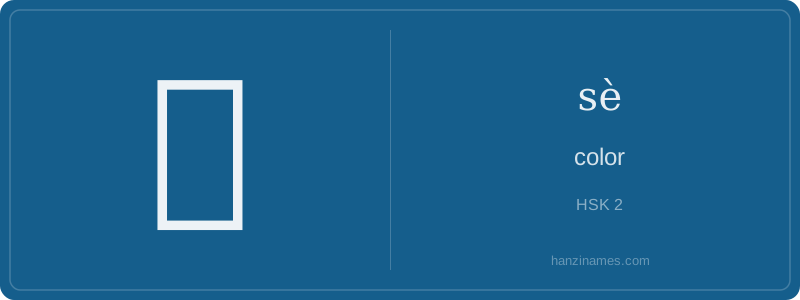
色 is ubiquitous in modern Chinese life: from traffic lights (红灯, 绿灯, 黄灯 — all using 色 implicitly in terms like ‘red light color’) to food descriptions (‘golden-brown color’ 棕色), cosmetics ads (‘natural skin tone color’ 自然肤色), and art classes. It appears in idioms like 五颜六色 (wǔ yán liù sè, ‘five faces, six colors’ → vividly colorful) and the Confucian phrase 巧言令色 (qiǎo yán lìng sè, ‘smooth talk and pleasing appearance’ — warning against superficial charm).
The earliest verified form of 色 appears in bronze inscriptions (c. 11th–3rd c. BCE) as a pictograph combining a person (人) and a bent line representing a face or expression — not a literal color swatch, but a person’s visible demeanor. Over time, it standardized into today’s shape, retaining its semantic link to observable appearance and hue.
Hi students! The character 色 (sè) is one of the most foundational and versatile characters in Chinese. At its core, it means 'color' — but don’t stop there! It’s also used metaphorically for appearance, mood, or even social connotations (like in words related to romance or aesthetics). As an HSK Level 2 character, you’ll see it early and often — from describing a red apple (红色) to expressing ‘a change in facial expression’ (变色). Its simplicity (just 6 strokes!) makes it great for practicing stroke order and radical recognition.
Notice that 色 is both a character and a radical — meaning it appears as a component in many other characters, like 艳 (yàn, ‘gorgeous’) and 色彩 (sècǎi, ‘colorfulness’). Though it looks abstract today, historically it evolved from ancient forms depicting a person with a face showing emotion or hue — linking color directly to human perception. This deep connection between sight, feeling, and expression remains central to how native speakers use it.
Be careful with pronunciation: sè is standard (e.g., in ‘color’, ‘mood’), while shǎi is a colloquial variant used only in specific northern dialects or fixed phrases like 什么色儿 (shénme shǎir, ‘what color?’). In formal writing and exams like HSK, always default to sè. Also, remember that 色 can carry subtle cultural weight — in classical texts, it’s part of the Buddhist term 色界 (sèjiè, ‘Realm of Form’), contrasting with emptiness — so context matters deeply!
Example Sentences
Common Compounds
Similar Characters — Don't Mix These Up
Your First Step into Chinese Culture: Get a Chinese Name
Every journey into Chinese begins with a name. Use our free Chinese name generator to create a meaningful, personalized Chinese name that fits you perfectly.
Get My Chinese Name →