药
Character Story & Explanation
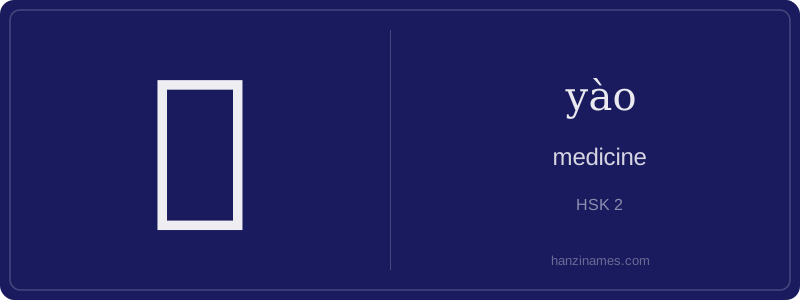
In daily life, 药 (yào) overwhelmingly means 'medicine' or 'drug'—used in pharmacies, hospitals, prescriptions, and health apps. Common phrases include '吃药' (chī yào, 'take medicine') and '中药' (zhōngyào, 'Traditional Chinese Medicine'). Historically, the earliest confirmed use appears in the Wushi'er Bingfang (Recipes for Fifty-Two Ailments, c. 168 BCE, Mawangdui), where 药 refers to prepared herbal substances—including iris-derived remedies.
The character is not pictographic; its form evolved from seal script (c. 200 BCE). The top 艹 (grass radical) signals plant origin; the bottom 约 (yāo/yào) was a phonetic component borrowed for sound, not meaning. No oracle bone form exists—its earliest attestation is in Warring States bamboo texts. Today, Chinese people see 药 on medicine boxes, hospital signs, and WeChat health consultations—always signaling treatment, safety, and care.
As an archaeologist sifting through bamboo slips from the Han dynasty, I found '药' inscribed not as medicine—but as a botanical notation: the iris leaf, specifically Iris tectorum, prized in early Chinese herbal manuals for its rhizome’s cooling properties. The character’s grass radical (艹) anchors it firmly in the plant world, while the right side '约' (yāo/yào), originally meaning 'to bind' or 'to regulate', hints at how this leaf was used to modulate bodily heat—a concept central to classical yin-yang theory.
Excavations at Mawangdui revealed silk manuscripts where '药' appears alongside diagrams of iris plants labeled with seasonal harvesting notes—spring leaves for detox, autumn roots for longevity. This confirms that 'leaf of the iris' wasn’t poetic metaphor but precise agronomic terminology. The character’s early form (c. 3rd century BCE) shows the grass radical above a simplified '约', suggesting controlled application—not random foraging, but ritualized botanical practice governed by calendrical and medical knowledge.
Later, as clinical pharmacology matured during the Tang, '药' expanded semantically to encompass all therapeutic substances—but its core glyph retained the iris leaf’s imprint. Even today, when modern TCM practitioners write '药', they trace the same strokes their Han-era predecessors did, preserving a 2,200-year continuity between botany, writing, and healing. The character is thus a palimpsest: a living artifact where etymology, ecology, and epistemology converge in nine decisive strokes.
Example Sentences
Common Compounds
Similar Characters — Don't Mix These Up
Your First Step into Chinese Culture: Get a Chinese Name
Every journey into Chinese begins with a name. Use our free Chinese name generator to create a meaningful, personalized Chinese name that fits you perfectly.
Get My Chinese Name →