呴
Character Story & Explanation
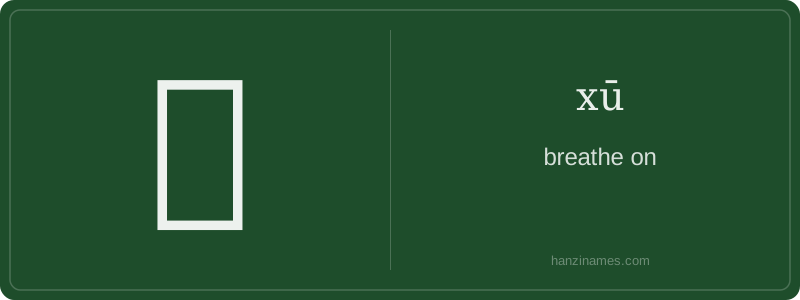
呴 (xū) is primarily attested in pre-Qin and Han dynasty texts, especially in Daoist and medical classics like the Huangdi Neijing (Yellow Emperor’s Inner Canon) and Zhuangzi, where it appears in paired terms like ‘呴濡’ (xū rú)—meaning ‘to breathe on and moisten’, symbolizing nurturing care. It is almost never used alone in modern speech, but survives in fixed literary phrases and historical idioms emphasizing compassionate sustenance.
The character combines the mouth radical (口) with the phonetic component 于 (yú), indicating pronunciation. While not a pictograph, its structure reflects its function: ‘mouth’ + sound cue. Today, Chinese learners encounter it mainly in classical reading courses or when studying traditional medicine—not in apps or street signs—but its conceptual weight endures in phrases like ‘相呴以湿’ (xiāng xū yǐ shī), meaning ‘to sustain each other with damp breath’ during hardship.
Imagine a crisp winter morning in Beijing’s Houhai neighborhood, where an elderly tai chi master stands by the frozen lake. With slow, deliberate movements, he exhales softly—xū—a gentle breath that mists the air. This isn’t just breathing; it’s 呴: the conscious, warming act of breathing *on* something—like blowing on cold hands or soothing a child’s scraped knee. In classical Chinese medicine and Daoist practice, 呴 embodies vital, nurturing breath—Qi directed outward with care and intention.
The character 呴 appears rarely in modern spoken Mandarin but remains alive in literary, medical, and philosophical texts. It belongs to a family of breath-related characters (like 吸 ‘xī’ – inhale, and 呼 ‘hū’ – exhale), but uniquely emphasizes *exhaling onto* a surface or being—to warm, revive, or comfort. Its rarity makes it a subtle marker of refined language, often found in idioms describing compassion or life-sustaining care.
While not used in daily conversation like ‘hello’ or ‘thank you’, 呴 surfaces in classical allusions, traditional healing manuals, and poetic descriptions of nature—such as mist rising from warm water or a mother bird warming chicks. For learners, encountering 呴 is like finding a quiet brushstroke in a grand ink painting: unobtrusive yet essential to the full expression of breath, warmth, and tenderness in Chinese thought.
Example Sentences
Common Compounds
Similar Characters — Don't Mix These Up
Your First Step into Chinese Culture: Get a Chinese Name
Every journey into Chinese begins with a name. Use our free Chinese name generator to create a meaningful, personalized Chinese name that fits you perfectly.
Get My Chinese Name →