呶
Character Story & Explanation
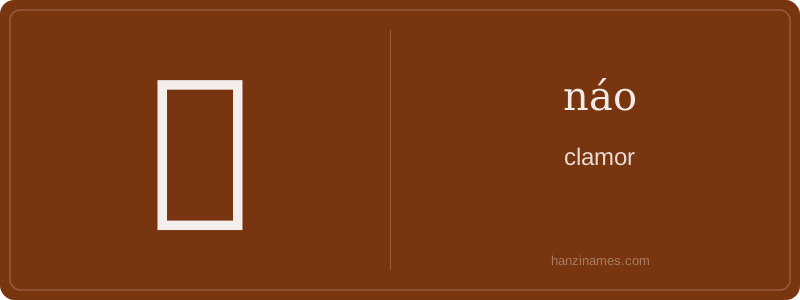
呶 is rarely used in contemporary formal writing but appears authentically in literary dialogue and regional speech — especially in northern Chinese novels and folk songs where it conveys emphatic, grumbling interjections (e.g., '呶,你看!' — 'Hey, look!'). It’s documented in the 1936 Dictionary of Commonly Used Dialect Words (《方言词典》) as a Shandong and Hebei colloquial particle expressing impatience or pointing. You’ll also find it in early 20th-century vernacular fiction by writers like Lao She, who used it to capture authentic Beijing street speech.
The character’s form is not pictographic. Its right component is a historical phonetic marker (related to náo/nǎo sounds), not a picture of anything. Today, Chinese learners encounter it mainly in annotated classical texts or dialect-based listening exercises — not in textbooks, but in real-life subtitles for regional dramas or documentary voiceovers where speakers say '呶' to mean 'look here!' or 'I’m telling you!'
Hi students! Let’s learn 呶 (náo), a lively character meaning 'clamor' or 'noisy protest'. It belongs to the 口 (kǒu, 'mouth') radical — which tells us it’s related to speech, sound, or vocal expression. With just 8 strokes, it’s relatively simple to write, but its usage is quite specialized: it’s mostly found in literary or dialectal contexts, not everyday spoken Mandarin. Don’t confuse it with common words like 叫 (jiào, 'to shout') — 呶 carries a sense of persistent, grumbling noise, like people complaining all at once.
This character has two standard pronunciations: náo (most common, meaning 'clamor') and the rarer nǔ (used only in certain classical or regional expressions, such as in old poetry or northern dialects). In modern Standard Mandarin, you’ll almost always hear náo. Though it’s not in the HSK vocabulary lists (HSK Level: Not included), understanding 呶 helps you recognize expressive, rhythmic language in literature, opera lyrics, or regional storytelling.
Writing 呶 follows a clear pattern: start with the 口 radical on the left (3 strokes), then add the right component — 匈 (xiōng) without the ‘勹’ top, simplified here as 十 + 口 — but wait! Actually, the right side is *not* 匈; it’s a phonetic component historically linked to náo sounds (like in 脑 nǎo, 'brain'). Don’t overthink the shape — focus on stroke order: left 口 first, then the right part top-to-bottom: horizontal, vertical, horizontal, then the final 口 inside. Practice slowly — consistency builds muscle memory!
Example Sentences
Common Compounds
Similar Characters — Don't Mix These Up
Your First Step into Chinese Culture: Get a Chinese Name
Every journey into Chinese begins with a name. Use our free Chinese name generator to create a meaningful, personalized Chinese name that fits you perfectly.
Get My Chinese Name →