呷
Character Story & Explanation
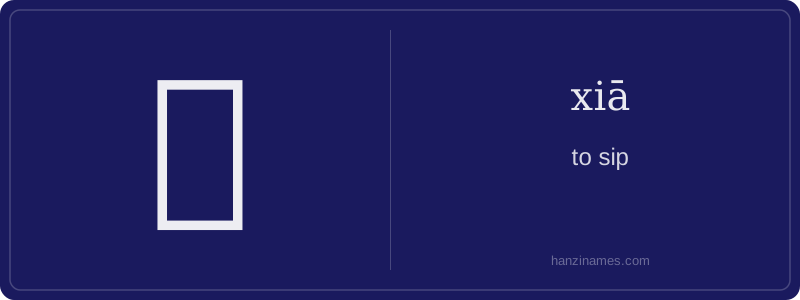
In contemporary Mandarin, 呷 is used primarily in literary, descriptive, or regional contexts—especially in novels, poetry, and spoken dialects like Sichuanese or Shanghainese—to evoke a gentle, conscious sip. It appears in fixed expressions like 呷茶 (xiā chá, 'to sip tea'), often conveying leisure, refinement, or quiet contemplation. While absent from HSK official lists (HSK Level: Not included), it’s recognized in the *Xiàndài Hànyǔ Cídiǎn* (Contemporary Chinese Dictionary) and frequently taught in advanced character courses for stylistic nuance.
The character is not pictographic—it has no oracle-bone or seal-script precursor. Instead, it emerged as a phono-semantic compound during late imperial times: 口 (kǒu, 'mouth') provides semantic context, and 合 (hé) serves as a phonetic hint (though pronunciation diverged to xiā). Today, you’ll hear it in teahouses when elders say '呷口热茶' ('take a sip of hot tea')—a warm, unhurried gesture anchoring daily ritual.
Our detective begins at the scene: the character 呷 appears in early modern Chinese texts—not ancient oracle bones or bronze inscriptions—but as a phonosemantic compound born from spoken language. Its 口 (mouth) radical signals oral action, while the phonetic component 合 (hé, 'to close/join') hints at the lip-and-tongue coordination required for sipping—closing the mouth slightly to draw liquid in gently. This isn’t a pictograph of a drinking vessel; it’s a linguistic fingerprint of vernacular speech crystallizing into script.
Zooming in on historical usage, 呷 first gained traction in regional Mandarin and Wu dialects during the Ming–Qing transition, appearing in vernacular novels like *The Plum in the Golden Vase* (c. 1610) to depict delicate, deliberate sips—often of tea or wine—contrasting with gulping (喝 hē) or swilling (灌 guàn). Its eight-stroke structure stabilized by the Kangxi Dictionary (1716), confirming its status as a functional, non-archaic character rooted in embodied action, not ritual symbolism.
Modern linguistic analysis confirms 呷 is a classic example of a ‘dialectal loan character’: originally representing a sound-meaning unit in northern and eastern speech, later adopted into standard written Chinese for stylistic precision. Unlike literary synonyms like 饮 (yǐn) or 啜 (chuò), 呷 carries an unmistakable sensory texture—soft, rhythmic, intimate. Its persistence across centuries reflects how Chinese writing absorbs lived behavior: not just *what* is drunk, but *how*—a whisper of breath, a pause between sips, captured in eight strokes.
Example Sentences
Common Compounds
Similar Characters — Don't Mix These Up
Your First Step into Chinese Culture: Get a Chinese Name
Every journey into Chinese begins with a name. Use our free Chinese name generator to create a meaningful, personalized Chinese name that fits you perfectly.
Get My Chinese Name →