呸
Character Story & Explanation
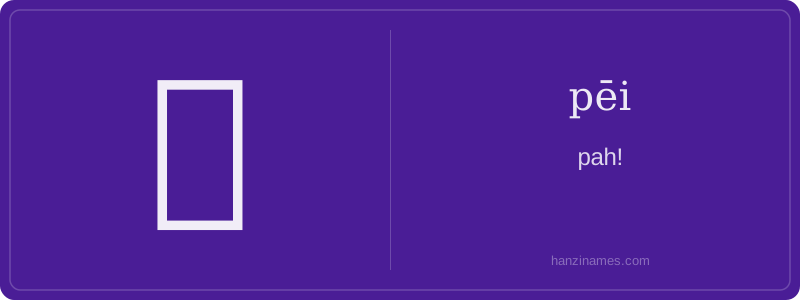
呸 is used today almost exclusively as an interjection expressing contempt, dismissal, or disgust—spoken with a sharp outward puff of air. It appears frequently in spoken Mandarin, film subtitles, and online forums (e.g., Weibo comments rejecting misinformation). While no classical idiom features 呸 as a core element, it commonly appears in colloquial phrases like ‘呸!谁稀罕!’ (‘Pah! Who cares!’). Historically, it’s documented in late imperial vernacular literature, including the 17th-century play The Peony Pavilion, where servants use it to scoff at pretension.
The character is not pictographic—it has no ancient pictorial origin. Instead, it’s a phono-semantic compound: 口 (mouth) signals vocalization, and 倍 (bèi) provides the sound /pēi/ via historical phonetic borrowing. Its form stabilized during the Ming–Qing transition and remains unchanged in modern standard script.
As an archaeologist sifting through layers of linguistic sediment, I find 呸 not etched on oracle bones nor cast in bronze—but vibrantly alive in the oral strata of Ming and Qing vernacular fiction. Its earliest attested uses appear in 16th-century novels like Jin Ping Mei, where characters spit out the syllable mid-argument, not as phonetic notation but as *graphically embodied sound*—a rare case where a character was created expressly to transcribe a paralinguistic interjection.
This character is a fossilized gesture: the 口 (mouth) radical anchors it in vocalization, while the right component 倍 (bèi, 'times') serves purely as a phonetic loan—its meaning irrelevant, its sound preserved. Unlike semantic compounds, 呸 carries zero lexical weight beyond its acoustic force; it’s a sonic artifact, not a conceptual one. Its eight strokes were standardized during the Kangxi Dictionary (1716), cementing its status as a ‘non-lexical grapheme’—a written shriek.
Modern corpus analysis reveals 呸 appears almost exclusively in dialogue, rarely in formal writing. It’s absent from classical poetry and bureaucratic documents, yet thrives in opera libretti, street theater scripts, and contemporary social media comments—where users deploy it like a digital spit-take. Its persistence confirms that Chinese orthography accommodates visceral human expression not through meaning, but through faithful, stylized transcription of breath, saliva, and scorn.
Example Sentences
Common Compounds
Similar Characters — Don't Mix These Up
Your First Step into Chinese Culture: Get a Chinese Name
Every journey into Chinese begins with a name. Use our free Chinese name generator to create a meaningful, personalized Chinese name that fits you perfectly.
Get My Chinese Name →