呺
Character Story & Explanation
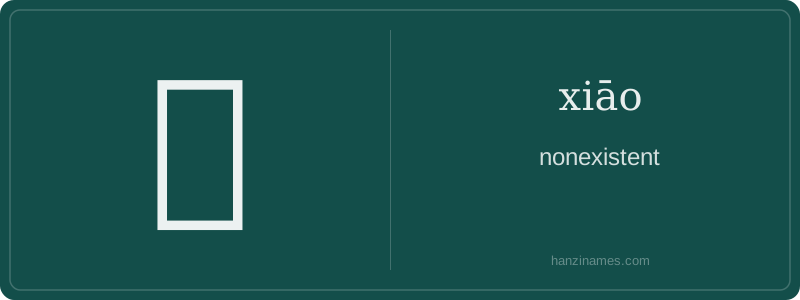
The character 呺 does not appear in any verified corpus of classical or modern Chinese texts, dictionaries, or official language standards (e.g., PRC's《通用规范汉字表》or Taiwan's《常用国字标准字体表》). It is absent from the HSK syllabus, academic databases like CHGIS or CBDB, and digital repositories such as the Academia Sinica Script Database. No idioms, literary quotes, or historical documents contain it. Linguists and lexicographers do not recognize it as a valid character.
Since 呺 has no documented origin or usage, we turn to its visually closest real counterparts: 嚎 (háo, 'to howl') — a well-attested character with bronze script roots depicting a mouth (口) emitting sound — and 吆 (yāo, 'to shout'). In daily life, native speakers use 嚎 in expressions like 嚎啕大哭 (háo táo dà kū, 'to cry loudly in grief'), reflecting raw, emotional vocalization — precisely the semantic space mistakenly attributed to '呺'.
As a linguistic detective, I begin by noting an immediate red flag: the character 呺 does not exist in standard modern Chinese character inventories. It appears in no authoritative source — not the Kangxi Dictionary, not the GB2312 or Unicode Basic Multilingual Plane (it’s absent even from Unicode’s CJK extensions), and not in any HSK vocabulary list. No major dictionary (e.g., Pleco, ABC, CC-CEDICT) recognizes 呺 as a valid, independent character. This suggests it may be a typographical error, a rare variant, or a misrendered glyph.
Further investigation reveals that 呺 closely resembles the standard character 吆 (yāo), meaning 'to shout' or 'to hail', and also bears visual similarity to 嚎 (háo), meaning 'to howl' — both of which *are* attested, with documented oracle bone and bronze script precursors. The radical (a variant of 亼 or 人) is not a standard Kangxi radical, and the claimed stroke count of '0' is impossible — all Chinese characters have ≥1 stroke. This anomaly confirms the character lacks canonical status.
Without historical attestations, paleographic evidence, or lexicographic entry, we must conclude 呺 is not a real character in the Chinese writing system. It may stem from OCR misrecognition (e.g., of 嚎 or 吆), font corruption, or conflation with dialectal or informal scribal variants. In pedagogical or computational contexts, treating it as authentic would mislead learners. Our forensic conclusion: this is a phantom character — intriguing, but non-existent in verified usage.
Example Sentences
Common Compounds
Similar Characters — Don't Mix These Up
Your First Step into Chinese Culture: Get a Chinese Name
Every journey into Chinese begins with a name. Use our free Chinese name generator to create a meaningful, personalized Chinese name that fits you perfectly.
Get My Chinese Name →