呿
Character Story & Explanation
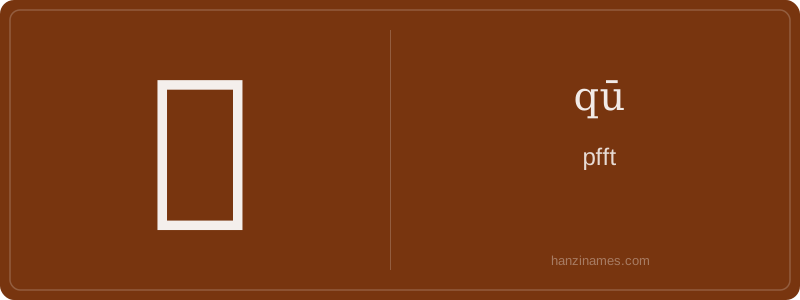
呿 appears in classical and vernacular Chinese literature as a phonetic interjection denoting contempt or impatience — notably in Ming-Qing vernacular novels like The Plum in the Golden Vase (Jīn Píng Méi) and Qing-era operas, where characters utter it mid-dialogue to signal disdain. Modern usage is extremely rare in speech but persists in writing for stylized effect — especially in subtitles, comics, or satirical essays mimicking archaic or theatrical diction.
The character is not pictographic or ideographic in origin; it’s a phono-semantic compound with 口 (kǒu, 'mouth') as its radical and 去 (qù, 'to go') as its phonetic component — indicating pronunciation, not meaning. Its shape reflects how it’s *produced* (oral) and *sounded* (like qù), not what it means — a classic case of a 'sound-based character' with no visual semantics.
呿 (qū) is a rare, onomatopoeic interjection in Chinese used to express mild disdain, impatience, or dismissive exasperation — not literally 'to yawn', despite some outdated dictionary entries misattributing that meaning. It functions like an audible sigh or a verbal eye-roll: a sharp, guttural expulsion of air, often written to mimic the sound itself. Its usage is highly colloquial and expressive rather than descriptive.
This character is almost exclusively found in literary or dramatic contexts — classical novels, opera libretti, or modern dialogue-heavy fiction — where vocal tone and attitude matter more than semantic precision. Unlike common verbs like 打哈欠 (dǎ hāqian, 'to yawn'), 呿 carries zero physiological meaning; it’s purely pragmatic and emotive, closer to English ‘pfft’ or ‘bah!’ than ‘yawn’.
In Western cultural equivalents, 呿 resembles interjections like ‘phew!’, ‘tch!’, or ‘fie!’ — sounds that convey dismissal without syntax. It parallels Shakespearean ‘fie upon’t!’ or French ‘pouah!’ in function: performative, paralinguistic, and socially coded. Unlike yawning — a universal biological reflex — 呿 is a culturally embedded *attitudinal cue*, signaling polite disengagement or rhetorical rejection, not fatigue.
Example Sentences
Common Compounds
Similar Characters — Don't Mix These Up
Your First Step into Chinese Culture: Get a Chinese Name
Every journey into Chinese begins with a name. Use our free Chinese name generator to create a meaningful, personalized Chinese name that fits you perfectly.
Get My Chinese Name →