咁
Character Story & Explanation
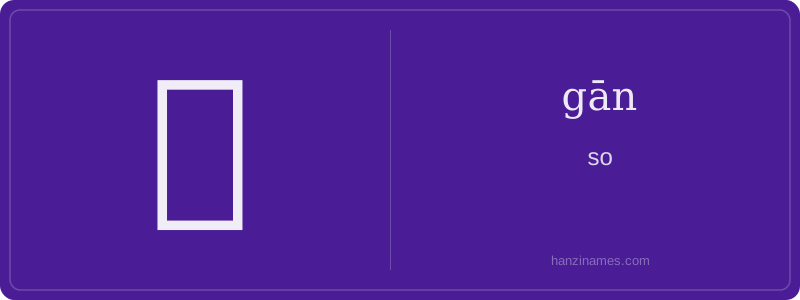
‘咁’ is a core Cantonese adverb meaning ‘so’ or ‘thus’, widely used in daily speech across Hong Kong, Guangzhou, and overseas Cantonese communities. It appears frequently in informal writing—social media, subtitles, local signage—and is recognized in the Hong Kong Supplementary Character Set (HKSCS) and Unicode (U+5481). Though absent from mainland China’s GB2312 standard, it’s taught in Hong Kong’s primary school Chinese curriculum as part of functional literacy.
‘咁’ is a phono-semantic compound: the ‘口’ (mouth) radical suggests speech-related function, while ‘甘’ (gām, ‘sweet’) provides phonetic approximation—though modern Cantonese pronunciation /gāam/ diverges slightly. No oracle-bone or seal-script form exists; it emerged organically in late imperial vernacular texts and solidified in 19th–20th century Cantonese publications, such as the 1930s Hong Kong newspaper South China Morning Post’s bilingual columns.
‘咁’ is not a standard Mandarin character—it belongs exclusively to Cantonese, a major Sino-Tibetan language spoken by over 60 million people in Guangdong, Hong Kong, Macau, and diaspora communities. Its presence reflects China’s profound linguistic diversity: while Putonghua (Mandarin) is the national standard, regional languages like Cantonese preserve distinct grammars, phonologies, and characters that encode local worldviews—where emphasis falls on relational nuance, contextual tone, and pragmatic immediacy rather than abstract universality.
In Cantonese thought, ‘咁’ embodies a worldview grounded in concrete comparison and situational awareness. Unlike Mandarin’s more formal ‘这么 (zhème)’ or ‘那么 (nàme)’, ‘咁’ functions as an unmarked, fluid intensifier—pointing directly to what’s perceptible *right here, right now*: ‘咁高’ (so tall), ‘咁快’ (so fast). This mirrors a cultural orientation valuing observable reality, embodied experience, and interpersonal resonance over detached generalization.
The character’s very existence challenges monolithic notions of ‘Chinese’. It signals that Chinese identity is not uniform but layered—like ink diffusing in rice paper: clear at the center, softly branching outward. Using ‘咁’ affirms belonging to a community where meaning emerges through shared speech rhythms, tonal precision, and colloquial warmth. It’s a quiet act of cultural continuity—preserving a linguistic lens honed over centuries of maritime trade, migration, and resilience in southern China.
Example Sentences
Common Compounds
Similar Characters — Don't Mix These Up
Your First Step into Chinese Culture: Get a Chinese Name
Every journey into Chinese begins with a name. Use our free Chinese name generator to create a meaningful, personalized Chinese name that fits you perfectly.
Get My Chinese Name →