咂
Character Story & Explanation
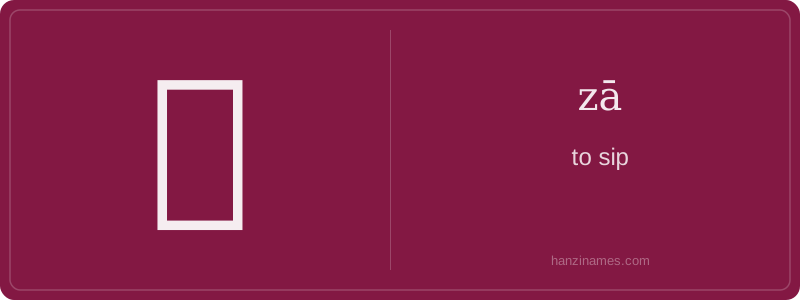
咂 is commonly used in modern Mandarin to describe the physical act of sipping or sucking with audible, appreciative attention — especially in informal or literary contexts. It appears in expressions like 咂摸 (zāmo, 'to fumble or examine carefully by touch/taste') and historically in classical texts such as the Ming-dynasty novel Jin Ping Mei, where characters 咂酒 (zā jiǔ, 'sip wine') to signal leisurely indulgence or discernment. It's also frequent in regional dialects (e.g., Northern Mandarin) for describing tasting food or testing quality.
The character is not pictographic in origin; it’s a phono-semantic compound. The left radical 口 indicates oral action, while the right component 匝 (zā) serves both phonetic and semantic roles — 匝 originally meant 'a complete circuit', reinforcing the circular, lingering motion of the tongue during sipping. No oracle bone or bronze script forms survive for 咂; it first appears reliably in Song-era dictionaries as a colloquial variant for refined tasting.
The character 咂 (zā) embodies a quiet, intimate moment of sensory engagement — the deliberate, often contemplative act of sipping. Unlike drinking (喝 hē), which implies consumption, 咂 emphasizes slow, attentive tasting: drawing liquid into the mouth, holding it, appreciating its texture and flavor. This reflects a broader Chinese cultural value — mindfulness in everyday acts, where even small gestures carry intentionality and aesthetic awareness.
In classical and modern usage, 咂 frequently appears in contexts of refinement and restraint: sipping tea, sampling wine, or even metaphorically 'savoring' experience. Its radical 口 (mouth) anchors it in embodied perception, while the right-side component 匝 (zā, meaning 'to encircle' or 'one full cycle') subtly evokes completeness — a full, rounded motion of the tongue and lips. This linguistic nuance reveals how Chinese sees perception not as passive reception but as active, cyclical participation.
Moreover, 咂 resists haste. In a culture that prizes harmony (和 hé) and balance (平衡 pínghéng), the act of 咂 mirrors the Daoist ideal of wu wei — effortless action achieved through patience and presence. It’s no accident that elders might 咂 tea while observing silence, or poets use 咂 to describe tasting memory or nostalgia. The character thus opens a window into a worldview where slowness is not inefficiency — it’s reverence.
Example Sentences
Common Compounds
Similar Characters — Don't Mix These Up
Your First Step into Chinese Culture: Get a Chinese Name
Every journey into Chinese begins with a name. Use our free Chinese name generator to create a meaningful, personalized Chinese name that fits you perfectly.
Get My Chinese Name →