咆
Character Story & Explanation
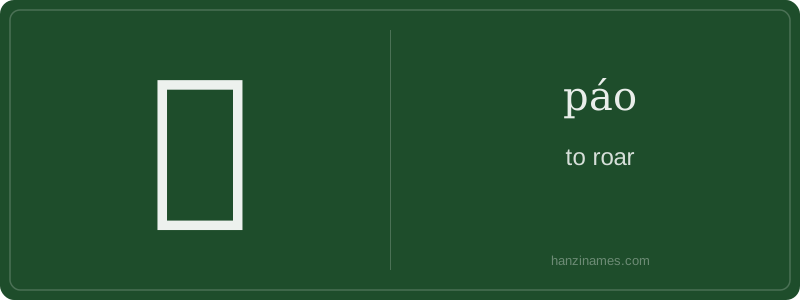
咆 is rarely used alone in modern Mandarin—it appears almost exclusively in fixed compounds like 咆哮 (páoxiāo, 'to roar') or literary/mimetic contexts. It features prominently in classical poetry (e.g., Du Fu’s ‘The Stone Fortress’ uses 咆哮 metaphorically for imperial wrath) and modern political rhetoric (e.g., ‘roaring tigers’ in economic reports). Media outlets use it for dramatic effect—news headlines about volcanic eruptions or protests often deploy 咆哮 for visceral impact.
The character is not pictographic; its origin lies in phono-semantic compounding: 口 (radical, meaning-related) + 包 (phonetic, approximating páo in Old Chinese). No oracle bone or bronze script form survives—its earliest attested use is in Warring States bamboo manuscripts (c. 4th century BCE), where it consistently denotes forceful, guttural vocalization.
As an archaeologist sifting through layers of linguistic sediment, I find 咆 not in oracle bones—but in the resonant echo of human voice and animal power. Its radical 口 (mouth) anchors it firmly in the realm of vocal expression, while the phonetic component 包 (bāo) hints at containment and release—like breath held then explosively expelled. This is no mere onomatopoeia; it’s a lexical fossil capturing the visceral physics of sound under pressure.
The character emerged during the late Warring States to early Han periods, appearing in bronze inscriptions and bamboo slips as a vivid descriptor of thunderous utterance—whether from lions, warriors, or poets channeling cosmic fury. Unlike quieter mouth-radical characters like 听 (to listen) or 吃 (to eat), 咆 carries seismic weight: it implies volume, intensity, and emotional rupture—often signaling loss of control or transcendent passion.
Its eight-stroke form conceals no pictographic lion or roaring mouth; instead, it evolved graphically from seal script where 包’s curved enclosure wrapped around 口, visually encoding the idea of sound bursting forth *from within*. Modern calligraphers still feel this tension—the final stroke of 包 sweeps outward like a shockwave, making 咆 one of the most dynamically kinetic characters in the 8-stroke range.
Example Sentences
Common Compounds
Similar Characters — Don't Mix These Up
Your First Step into Chinese Culture: Get a Chinese Name
Every journey into Chinese begins with a name. Use our free Chinese name generator to create a meaningful, personalized Chinese name that fits you perfectly.
Get My Chinese Name →