咑
Character Story & Explanation
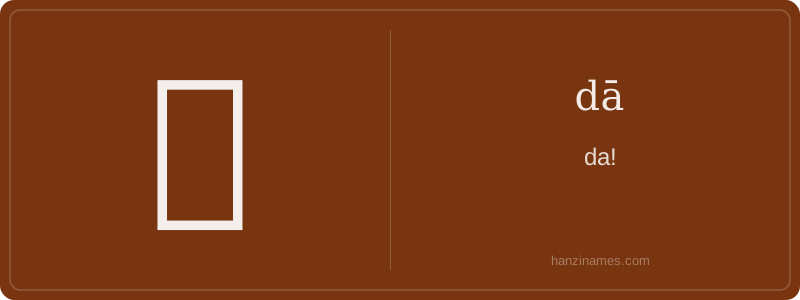
咑 (dā) is virtually absent from classical texts, modern dictionaries, and official HSK vocabulary lists. It does not appear in the 2021 HSK 1–6 syllabi and is not assigned an HSK level. In contemporary usage, it functions almost exclusively as an onomatopoeic interjection in informal, visual media—especially webcomics (manhua), animated subtitles, and social media comments where users mimic abrupt vocal reactions. While no standardized idiom contains 咑, it frequently appears in phrase-like constructions such as '咑一下' (dā yí xià), meaning 'a quick 'da!'—used humorously to signal minor surprise or mock-dramatic pause.
The character is a modern phono-semantic compound: 口 (mouth radical) signals vocal origin; the right side '大' (dà, 'big') hints at pronunciation (dā is a close phonetic variant of dà) and suggests amplification—'big sound'. Unlike ancient characters derived from oracle bones, 咑 emerged in late 20th-century printed vernacular literature and gained traction online post-2010 as internet users sought expressive, non-standard glyphs for vocal emphasis.
Imagine stepping into a bustling Beijing hutong on a sunny afternoon—children dart between courtyard gates, and suddenly, a boy trips over a loose brick. Before he even hits the ground, his friend shouts '咑!'—a sharp, playful exclamation like 'Whoa!' or 'Oops!' It’s not a word with dictionary definition, but a vocal burst: spontaneous, mouth-shaped (hence the 口 radical), and deeply embedded in oral Chinese expression. This character captures sound, not semantics—like English 'uh-oh' or 'yikes', but written.
咑 is a phonetic logograph: it doesn’t denote an object or concept, but imitates a sudden, voiced stop-sound—/dɑ/—produced with the mouth open and tongue striking the alveolar ridge. Its eight strokes follow a clear pattern: starting with the 口 radical (three strokes), then the right-side component '大' (five strokes), visually echoing 'big mouth + big sound'. Though rare in formal writing, it thrives in comics, children’s books, and digital slang as an onomatopoeic intensifier.
Unlike standard vocabulary, 咑 appears almost exclusively in expressive, performative contexts—think cartoon speech bubbles, online memes ('咑!这题太难了!'), or teachers using exaggerated intonation to grab students’ attention. It carries no grammatical function, yet conveys tone, timing, and emotional punctuation. For learners, mastering 咑 isn’t about memorizing meaning—it’s about recognizing how Chinese script accommodates the full spectrum of human vocalization, from laughter to alarm.
Example Sentences
Common Compounds
Similar Characters — Don't Mix These Up
Your First Step into Chinese Culture: Get a Chinese Name
Every journey into Chinese begins with a name. Use our free Chinese name generator to create a meaningful, personalized Chinese name that fits you perfectly.
Get My Chinese Name →