咒
Character Story & Explanation
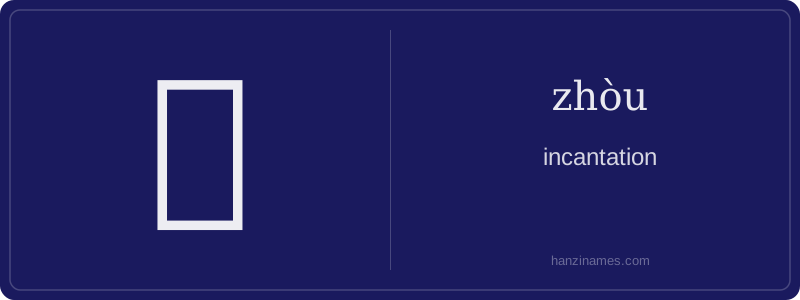
In contemporary Chinese, 咒 appears most commonly in compound words like 咒语 (zhòuyǔ, 'incantation') and 禁咒 (jìnzhòu, 'taboo incantation'), especially in fantasy literature, video games (e.g., *Genshin Impact* localized as 'artifacts with ancient咒'), and translated Buddhist sutras. It rarely stands alone in speech; native speakers almost never say 'a 咒' — instead using phrases like '念咒' (niàn zhòu, 'recite an incantation'). Historically, it appears in Tang dynasty Dunhuang manuscripts describing Daoist talismans and medical exorcism rites.
The character’s form is not pictographic but phono-semantic: 口 (kǒu, 'mouth') signals meaning related to speech, while 乍 (zhà) provides approximate sound. No oracle-bone or bronze inscriptions of 咒 survive — its earliest confirmed appearance is on late Warring States bamboo texts (c. 300 BCE), where it consistently denotes ritual utterances prescribed in official ceremonial handbooks.
As an archaeologist sifting through bamboo slips from the Warring States period, I found 咒 etched not as a mystical glyph, but as a functional linguistic artifact: mouth (口) + crossing strokes — symbolizing spoken words with binding force. Early inscriptions show it paired with ritual verbs like 'recite' and 'invoke', confirming its role in formalized speech acts long before Taoist or Buddhist liturgies absorbed it.
The character’s eight-stroke structure reveals deliberate design: the 口 radical anchors it in vocalization, while the right component (乍) originally denoted 'sudden emergence' — suggesting words that manifest effect instantly. This aligns with excavated Chu silk manuscripts where 咒 appears in healing texts, always preceding verbs of activation ('to cast', 'to seal'), never standing alone as a noun.
Unlike later folk associations with curses, early usage was neutral — a technical term for ritually authorized speech. Even in the Han dynasty *Shuowen Jiezi*, it’s defined as 'words spoken with solemn intent to move spirits or alter reality', devoid of inherent good/evil valence. Its semantic gravity comes from performative authority, not moral charge — a nuance lost in modern colloquial narrowing to 'curse'.
Example Sentences
Common Compounds
Similar Characters — Don't Mix These Up
Your First Step into Chinese Culture: Get a Chinese Name
Every journey into Chinese begins with a name. Use our free Chinese name generator to create a meaningful, personalized Chinese name that fits you perfectly.
Get My Chinese Name →