咗
Character Story & Explanation
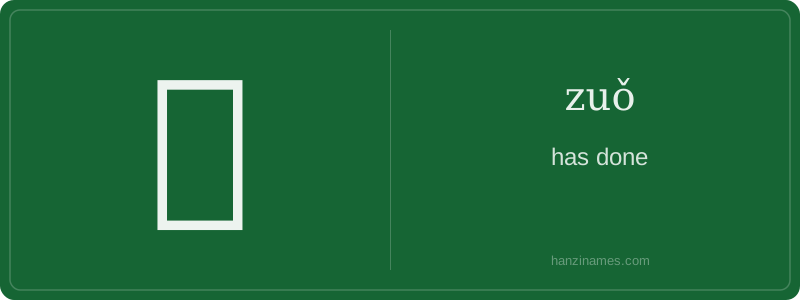
咗 is ubiquitous in modern Hong Kong and Guangdong informal writing—used daily in WhatsApp chats, forum posts, and TVB drama subtitles. It appears in fixed collocations like ‘食咗飯’ (sik6 zo2 faan6, ‘has eaten rice’) and ‘去咗’ (heoi3 zo2, ‘has gone’). No historical oracle-bone or seal script form exists; it emerged in late 20th-century vernacular Cantonese orthography as a phonetic loan character, replacing earlier inconsistent spellings (e.g., ‘佐’, ‘左’) to standardize the /zɔː/ sound.
The character 咗 is a phono-semantic compound: the mouth radical 口 (kau2) signals speech/orality, while the phonetic component 左 (zo2, ‘left’) provides approximate pronunciation. This borrowing is documented in the 1997 Hong Kong Supplementary Character Set (HKSCS) and formally encoded in Unicode 3.0 (U+5484) — confirming its institutional recognition as a distinct, functional grapheme in digital Cantonese.
咗 (zuǒ) is not a standard Mandarin character—it’s a Cantonese-specific written particle used exclusively in informal, colloquial Cantonese writing (e.g., social media, text messages, subtitles, or local signage). It functions identically to the Mandarin perfective aspect marker 了 (le) and the experiential marker 過 (guò), signaling completed action or prior experience. Unlike Mandarin’s standardized script, 咗 reflects Cantonese phonology and grammar, making it essential for authentic spoken-to-written Cantonese correspondence.
This character has no place in formal education curricula like HSK, nor does it appear in classical texts or mainland Chinese official documents. Its usage is entirely regional and pragmatic: it’s pronounced /zɔː˩/ (low falling tone) in Jyutping, matching the Cantonese pronunciation of the verb ‘to finish’—a semantic extension from ‘done’ → ‘completed action’. Linguistically, it’s a grammaticalization of the verb ‘to finish’, similar to how English uses ‘done’ in ‘I’m done eating’.
In Western linguistic terms, 咗 operates like the English perfect auxiliary ‘have’ + past participle (e.g., ‘I have eaten’) or the simple past tense marker ‘-ed’, but with stronger emphasis on resultative completion. It’s not a tense marker per se, but an aspectual one—focusing on whether an action is *finished*, not *when*. This mirrors how German ‘sein’ + past participle signals resultant state (e.g., ‘Er ist gegangen’), or French passé composé (‘Il a mangé’), both encoding completion rather than time alone.
Example Sentences
Common Compounds
Similar Characters — Don't Mix These Up
Your First Step into Chinese Culture: Get a Chinese Name
Every journey into Chinese begins with a name. Use our free Chinese name generator to create a meaningful, personalized Chinese name that fits you perfectly.
Get My Chinese Name →