咚
Character Story & Explanation
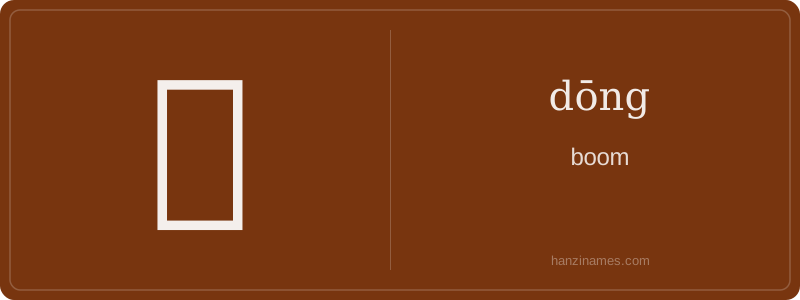
咚 is exclusively an onomatopoeic interjection in modern Standard Chinese—used orally and in writing to represent a deep, resonant 'boom' or 'thud'. It appears frequently in children’s books (e.g., *The Little Drummer Boy* translations), comic strips (*Manhua*), and subtitles for sound effects in films and animations. While absent from classical texts, it is codified in the *Xiandai Hanyu Cidian* (7th ed., 2016) and used daily in spoken Mandarin to punctuate actions: e.g., ‘咚!门关上了。’ (Boom! The door shut.)
Its written form is not pictographic—it bears no resemblance to drums or sound waves. Instead, it evolved as a phonetic approximation using the 口 radical (to mark it as vocalized) and the phonetic component 冬 (dōng, ‘winter’) for pronunciation. This is a classic example of a *xíngshēng* (phono-semantic compound), though the semantic part (口) only signals ‘uttered sound’, not meaning.
As an archaeologist sifting through layers of linguistic sediment, I find 咚 not in oracle bones or bronze inscriptions—but in the living strata of modern Chinese speech: it is a *phonetic loan character* (假借字), born not from ancient pictography but from urgent onomatopoeic need. Its earliest documented appearances appear in late Qing and Republican-era vernacular fiction and children’s literature, where writers urgently required a written form for the resonant, percussive ‘boom’ of drums, doors, or falling objects—sounds too visceral for classical monosyllabic verbs like 敲 (to strike) or 震 (to shake).
This character reveals how Chinese orthography adapts pragmatically: though it carries the 口 (mouth/speech) radical—signaling its vocal, expressive nature—it has no semantic component tied to sound production. Its eight strokes were standardized in the 1956 *List of Commonly Used Characters*, confirming its status as a modern functional glyph rather than a historical relic. Unlike ancient characters carved for ritual divination, 咚 was forged in the printing press and schoolroom—designed for clarity, not cosmology.
Its absence from pre-20th-century dictionaries (e.g., *Kangxi Zidian*) is telling: 咚 didn’t emerge from philosophical abstraction or celestial observation, but from the audible world—street vendors’ gongs, temple bells, cartoon sound effects in *Lianhuanhua*, and later, digital emoticons. As such, it stands as material evidence of how language fossilizes lived experience: not in stone, but in the echo of a door slamming shut in a Beijing *hutong* at dusk.
Example Sentences
Common Compounds
Similar Characters — Don't Mix These Up
Your First Step into Chinese Culture: Get a Chinese Name
Every journey into Chinese begins with a name. Use our free Chinese name generator to create a meaningful, personalized Chinese name that fits you perfectly.
Get My Chinese Name →