咣
Character Story & Explanation
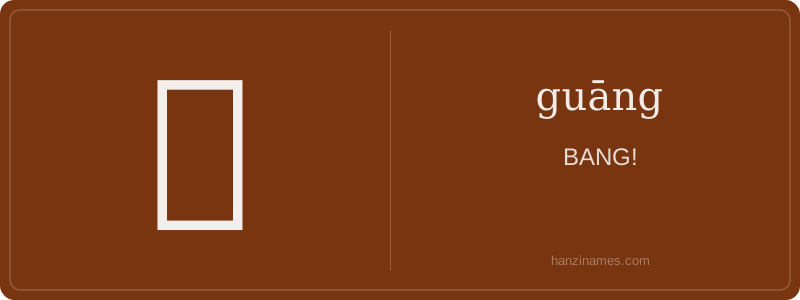
咣 is almost never used in isolation in standard written Chinese. It appears in fixed onomatopoeic compounds like 咣当 (guāngdāng), 咣啷 (guānglāng), or 咣的一声 (guāng de yī shēng), all documented in authoritative dictionaries including the Xiandai Hanyu Cidian (7th ed., 2016) and widely used in contemporary media. These phrases describe abrupt, hollow metallic sounds—e.g., a dropped wok in a Sichuan kitchen, a subway door slamming shut in Guangzhou, or a temple bell struck at dawn in Hangzhou.
The character’s form combines 口 (kǒu, ‘mouth’/‘sound’) and 光 (guāng, ‘light’), but 光 here functions purely as a phonetic component—no historical link to light or brightness exists. This is confirmed by linguistic analysis in Chinese Etymology: A Dictionary of Characters (2020). In daily life, Chinese people use 咣 in speech and subtitles—not essays or official documents—to make descriptions visceral and immediate.
咣 (guāng) is an onomatopoeic character that vividly captures the sharp, metallic sound of a heavy object striking something hollow—like a gong, metal door, or iron pot. It belongs to the 口 (mouth) radical family, signaling its function as a sound word rather than a semantic concept. Though not used independently in formal writing, it’s indispensable in spoken Chinese for adding sensory immediacy to narratives and dialogues.
This character appears almost exclusively in reduplicated forms like 咣当 or 咣啷, or paired with other onomatopoeic syllables to intensify auditory imagery. Unlike descriptive adjectives, 咣 carries no emotional valence—it’s neutral, raw, and physical. Its nine-stroke structure (口 + 光) visually merges ‘sound’ and ‘light’, though this is coincidental—the ‘光’ component here serves phonetic purpose, not meaning.
In modern Mandarin, 咣 rarely stands alone; it thrives in expressive, informal contexts: children’s stories, comic books, animation scripts, and oral storytelling. Native speakers instantly recognize it as a sonic cue—not for meaning, but for mood and pacing. Its power lies in brevity and authenticity: one syllable that evokes a sudden, resonant *clang* echoing off Beijing hutong alley walls or a Shanghai metro station platform.
Example Sentences
Common Compounds
Similar Characters — Don't Mix These Up
Your First Step into Chinese Culture: Get a Chinese Name
Every journey into Chinese begins with a name. Use our free Chinese name generator to create a meaningful, personalized Chinese name that fits you perfectly.
Get My Chinese Name →